
SEO vs GEO: Which One Does Your Business Actually Need?
Search is changing faster than ever. A few years ago, getting to the first page of Google was the biggest goal for most businesses. Today, people are asking questions directly in ChatGPT, reading Google AI Overviews, checking Perplexity, and expecting instant answers before clicking a website.
That shift has introduced a new term into digital marketing conversations: GEO, or Generative Engine Optimisation.
Many business owners now wonder whether SEO is becoming outdated or if they should invest in GEO instead. The reality is much simpler. SEO and GEO are not competitors-they solve different parts of the same visibility challenge.
If your business wants to stay visible across Google Search and AI-powered search experiences, understanding the difference between SEO vs GEO is becoming increasingly important.
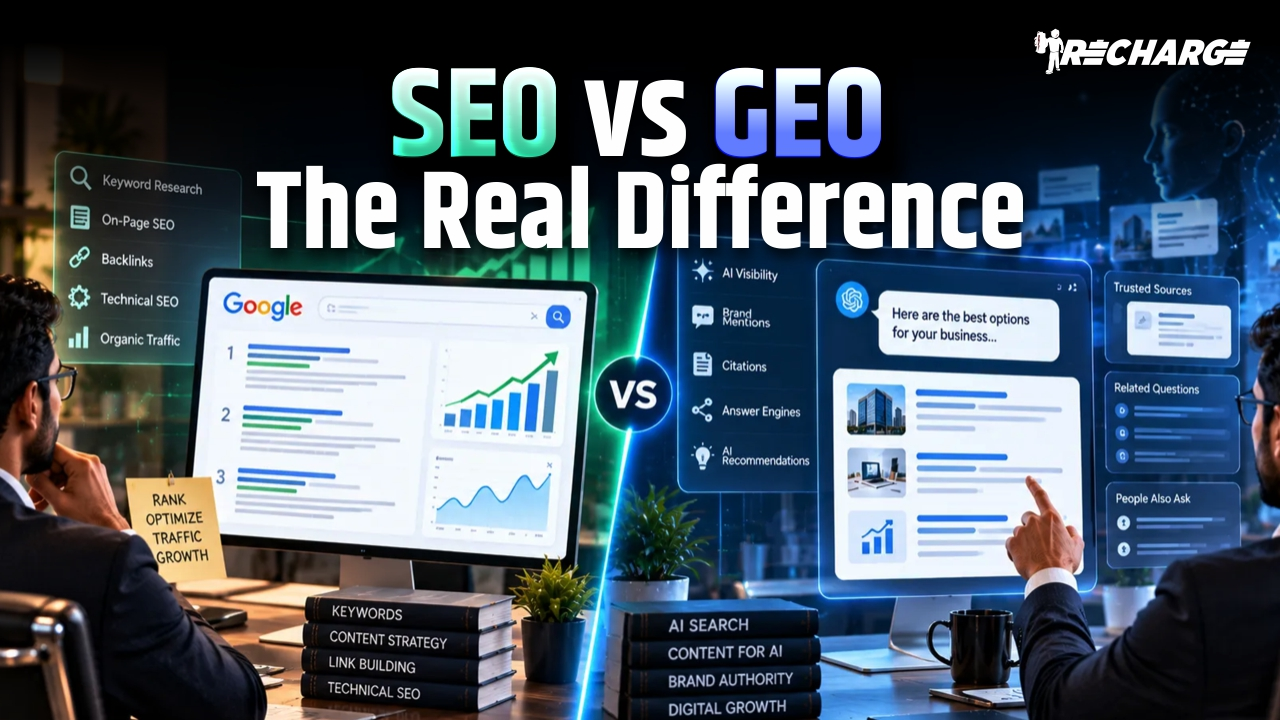
SEO builds organic visibility, while GEO helps AI understand your content
The biggest difference is that SEO focuses on helping your website rank in traditional search results, while GEO focuses on increasing your chances of being surfaced or cited by AI-powered search experiences like ChatGPT and Google AI Overviews.
SEO (Search Engine Optimisation) improves your website’s visibility in search engines by making pages relevant, technically strong, and useful for users.
GEO (Generative Engine Optimisation) focuses on making your content easier for generative AI systems to understand, trust, and reference when answering questions.
The relationship looks like this:
| SEO | GEO |
| Traditional Google rankings | AI-generated answers |
| Organic search traffic | AI search visibility |
| Keyword optimisation | Context and entity optimisation |
| Search intent | Conversational intent |
| Website clicks | Citations and mentions |
The important thing to remember is that GEO doesn’t replace SEO. Instead, it builds on many of the same quality signals.
What is Generative Engine Optimisation (GEO)?
Generative Engine Optimisation is the process of improving how your brand and content appear in AI-powered search experiences.
Instead of only targeting keyword rankings, GEO helps your content become useful enough for AI systems to reference when generating answers.
For example, someone might ask:
“What’s the best marketing strategy for a startup?”
Rather than listing ten websites, ChatGPT or Google AI Overviews may combine information from several trusted sources into one response.
Your goal is to become one of those trusted sources.
Effective generative search optimisation usually involves:
- Original content
- Clear explanations
- Strong topical authority
- Trustworthy information
- Good website structure
- Helpful internal linking
Businesses exploring long-term AI visibility often combine GEO with broader digital marketing strategies rather than treating it as a separate tactic. You can see how that fits into a full-service approach on the Recharge Studio website .
AEO and GEO are related, but they are not the same
Another term that’s becoming popular is AEO, which stands for Answer Engine Optimisation.
If you’ve searched for what is AEO or AEO meaning, the easiest way to understand it is this:
- SEO helps people find your website.
- AEO helps answer engines deliver direct answers.
- GEO helps generative AI build better responses using trustworthy information.
Think of them as three connected layers.
| Optimisation | Main Goal |
| SEO | Rank webpages |
| AEO | Answer questions directly |
| GEO | Improve AI-generated visibility |
For businesses, this means your content should answer questions clearly before expanding into detailed explanations.
That’s one reason conversational content performs better in modern search experiences.
Businesses still need SEO because AI search depends on strong foundations
Some marketers believe AI SEO has replaced traditional optimisation.
It hasn’t.
Google’s AI-powered search experiences continue to rely on many of the same quality signals that support regular Search visibility. Good technical SEO, crawlable pages, helpful content, and clear site structure still matter.
Start with the basics.
Make sure your website has:
- Fast loading pages
- Mobile-friendly design
- Clear heading structure
- Internal linking
- Indexable pages
- Helpful content
- Logical navigation
When these foundations are strong, AI systems have a much easier time understanding your website.
For example, if someone reads about generating business enquiries, they should naturally discover relevant examples through connected content like Recharge Studio’s Lead Generation portfolio rather than reaching a dead end.
GEO works best when your content demonstrates real expertise
One of the biggest ranking factors in AI search is credibility.
AI systems already have access to thousands of similar articles. They don’t need another generic blog repeating basic advice.
Instead, they reward content that offers something genuinely useful.
That means including:
- Real campaign insights
- Practical examples
- Updated information
- Original observations
- Clear explanations
- Trustworthy references
For example, instead of writing:
“Social media helps businesses grow.”
Explain how combining paid advertising, organic content, and conversion-focused landing pages improved results for a business.
That kind of practical experience strengthens E-E-A-T signals and improves overall content quality.
A connected content strategy also helps. Businesses interested in improving brand visibility can explore how Social Media Marketing works alongside broader digital campaigns instead of treating every channel separately.
SEO and GEO work better together than apart
The smartest businesses aren’t choosing between SEO vs GEO.
They’re combining both.
A practical strategy looks like this:
Continue investing in SEO
- Improve technical performance.
- Build topical authority.
- Strengthen internal linking.
- Optimise important service pages.
- Publish useful content consistently.
Add GEO-friendly improvements
- Answer real customer questions.
- Use conversational language.
- Build entity-based content.
- Include original insights.
- Make information easy to understand.
This combination improves visibility across Google Search, ChatGPT, Google AI Overviews, Bing Copilot, and other AI-powered search experiences.
Businesses running campaigns across multiple channels often see stronger results when content, paid marketing, and brand messaging work together, similar to Recharge Studio’s Multi-Channel Campaign approach .
The future belongs to businesses that optimise for both people and AI
Search is no longer limited to one platform.
Customers might discover your brand through Google Search, ask ChatGPT for recommendations, compare answers in Perplexity, and only then visit your website.
That’s why the question isn’t whether GEO will replace SEO.
The better question is:
How can your content become valuable wherever people search?
The businesses that win in AI search are usually the same ones creating trustworthy, helpful, and experience-driven content consistently.
If you’re planning your next SEO strategy or want to prepare your website for AI-powered search, you can contact Recharge Studio or book a meeting to discuss practical ways to improve long-term search visibility.
Conclusion
The debate around SEO vs GEO doesn’t have a single winner because both play different roles. SEO helps people discover your website through traditional search, while Generative Engine Optimisation improves how AI systems understand and surface your content.
As AI-powered search continues to grow, businesses don’t need to abandon SEO. They need to strengthen it while creating content that’s useful enough for AI to trust.
The best long-term strategy is simple: create original content, build authority, maintain strong technical SEO, and optimise for real conversations-not just keywords.
FAQs
1. What does GEO stand for?
GEO stands for Generative Engine Optimisation. It focuses on improving how websites and brands appear in AI-generated search experiences like ChatGPT, Google AI Overviews, and other conversational search platforms.
2. What is the difference between SEO and GEO?
SEO improves rankings in traditional search engines, while GEO helps AI systems understand and potentially reference your content when generating answers. Both rely on helpful content, technical quality, and trust.
3. What is AEO?
AEO means Answer Engine Optimisation. It focuses on creating content that answers user questions clearly so answer engines can present direct responses more effectively.
4. Can SEO and GEO work together?
Yes. The strongest strategy combines traditional SEO with GEO-friendly content. Technical optimisation, topical authority, conversational content, and real expertise work together across both search experiences.
5. How do I optimise for ChatGPT and Google AI Overviews?
Focus on original content, clear answers, strong internal linking, technical SEO, trustworthy information, and topical authority. These fundamentals help improve visibility across both traditional and AI-powered search.
Branding vs Marketing: What’s the Difference?
Branding and marketing are often used interchangeably, but they are not the same thing. A business can have a strong marketing campaign and still struggle to build recognition. Similarly, a well-designed brand may not grow if customers are not being reached through effective marketing.
Understanding branding vs marketing helps businesses make better decisions about where to invest their time and budget.
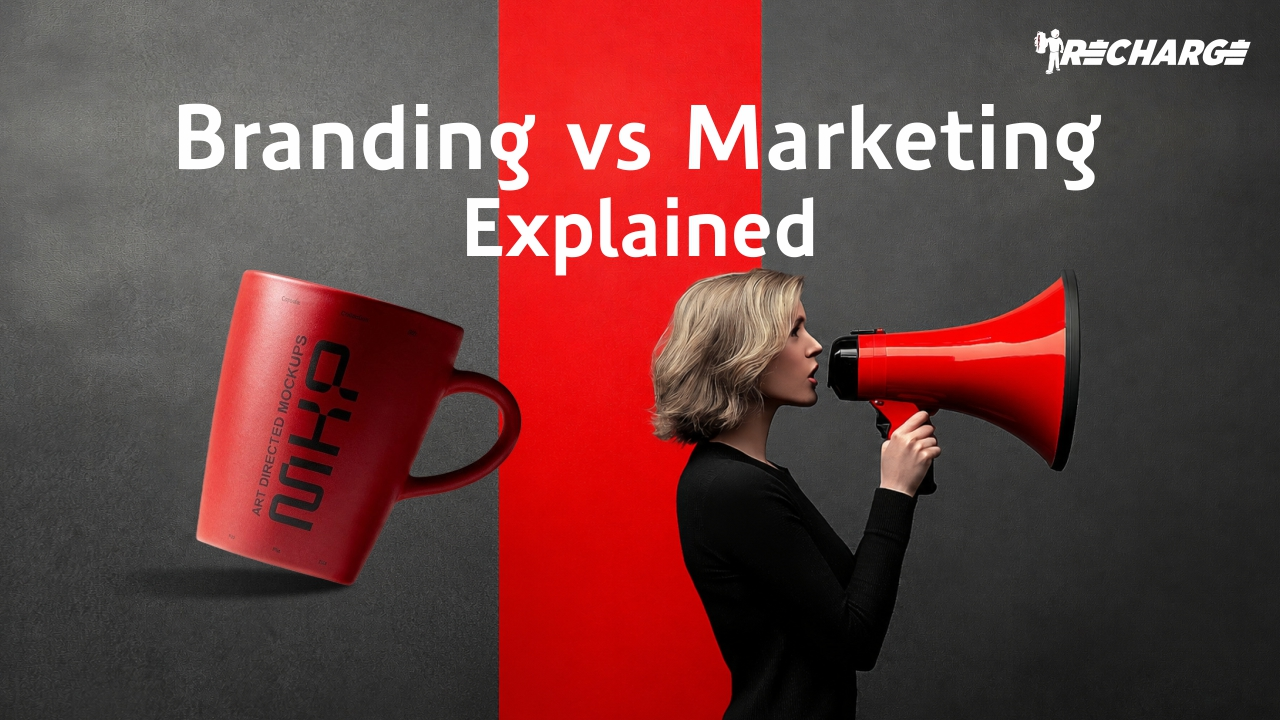
Branding shapes how people perceive and remember a business. Marketing is how that business communicates its value, reaches potential customers and encourages them to take action. One builds the foundation; the other actively takes that brand into the market.
For growing businesses, the real opportunity is not choosing branding or marketing. It is understanding how both work together to create a consistent customer journey from awareness to conversion and retention.
What Is Branding?
Branding is the process of defining and shaping how people recognise and perceive your business. It goes far beyond choosing a logo or colours.
A strong brand can include:
- Brand identity
- Brand positioning
- Brand personality
- Brand voice
- Brand messaging
- Visual identity
- Logo design
- Brand guidelines
- Value proposition
- Brand reputation
Branding answers questions such as Who are we? What do we stand for? Who do we serve? Why should customers remember us?
For example, two companies may offer similar services, but customers may perceive one as more premium, innovative, trustworthy or approachable because of its branding.
This is why business branding plays an important role in differentiation and customer perception.
What Is Marketing?
Marketing focuses on getting your business, products or services in front of the right audience and encouraging them to take action.
A marketing strategy can include:
- SEO
- PPC and paid advertising
- Content marketing
- Social media marketing
- Email marketing
- Performance marketing
- Lead generation
- ATL marketing
- BTL marketing
- TTL marketing
- Multi-channel marketing
Marketing is closely connected to the customer journey. It can help a business generate awareness, attract website visitors, nurture prospects and ultimately drive enquiries, purchases or other conversions.
In simple terms, branding creates the identity, while marketing communicates and promotes it.
Branding vs Marketing: What Is the Difference?
The main difference between branding and marketing is their purpose.
| Branding | Marketing |
| Defines who the business is | Promotes what the business offers |
| Builds recognition and perception | Generates awareness, traffic and demand |
| Focuses on long-term identity | Often focuses on specific campaigns and objectives |
| Creates consistency | Uses channels to reach customers |
| Builds emotional connection | Encourages action and conversion |
Branding is the foundation behind how your business presents itself. Marketing uses that foundation to communicate with the market.
A campaign may generate thousands of clicks, but if the brand experience is inconsistent, customers may struggle to remember or trust the business.
Brand Strategy vs Marketing Strategy
A brand strategy focuses on the long-term direction and positioning of the brand. It considers your target audience, competitive positioning, personality, messaging and the perception you want to create.
A marketing strategy focuses on how you will reach that audience and achieve business objectives through specific channels and campaigns.
For example, a brand strategy may establish a business as a premium, expert-led service provider. The marketing strategy can then use SEO, PPC, content, social media and email marketing to communicate that positioning to potential customers.
This distinction is important because marketing campaigns should not feel disconnected from the brand.
Does Branding Come Before Marketing?
Ideally, branding should provide a clear foundation before major marketing activity begins. Your audience, positioning, messaging and visual identity should be reasonably defined before investing heavily in campaigns.
However, branding and marketing are not completely linear.
Existing businesses can discover through marketing campaigns that customers perceive their brand differently from what they intended. That insight can lead to improvements in messaging, positioning or visual identity.
So, while branding often comes first strategically, both areas should continue developing together.
Why Branding Is Important for Business
Strong branding can make your business easier to recognise and differentiate in a competitive market.
When customers repeatedly encounter consistent messaging, visuals and experiences, they can begin to associate those elements with your company.
Effective branding can support:
- Brand recognition
- Customer trust
- Brand differentiation
- Customer loyalty
- Stronger customer perception
- Consistent communication
- Competitive positioning
This becomes particularly valuable when several businesses offer similar products or services. A distinctive brand gives customers another reason to remember and choose you.
Why Marketing Is Important for Business
Even a strong brand needs visibility. Marketing helps connect the brand with potential customers.
Effective marketing can help businesses:
- Reach target audiences
- Generate website traffic
- Create leads
- Increase enquiries
- Drive sales
- Build brand awareness
- Retain customers
- Measure campaign performance
SEO can help capture people actively searching for solutions. Paid advertising can reach targeted audiences quickly. Social media can build engagement, while content marketing can demonstrate expertise.
The strongest results often come when these activities work together rather than operating as disconnected campaigns.
Branding vs Marketing for Small Businesses
For small businesses, deciding where to invest can be particularly challenging.
Marketing may appear more urgent because it can generate immediate traffic and leads. However, investing only in marketing without a clear brand can result in inconsistent messaging and weak differentiation.
At the same time, spending heavily on branding without having a plan to reach customers may not produce meaningful business growth.
A practical approach is to establish a clear brand foundation and then build marketing activities around it.
For example, define your positioning, target audience, messaging and visual identity first. Then use SEO, social media, paid advertising, content and lead generation to reach that audience.
How Branding and Marketing Work Together
Think of branding as the identity and promise, while marketing is the communication and distribution.
A customer might first discover your business through a Google search. They then visit your website, see your visual identity, read your content, view social media posts and eventually contact your team.
Every interaction contributes to their perception of your brand.
If your branding says “premium and professional” but your website, advertisements and social media feel inconsistent, the customer experience becomes confusing.
Strong branding and marketing strategy keeps the message consistent across channels while adapting the communication to each platform.
Branding vs Marketing: Which Is More Important?
Neither is more important in isolation.
Branding gives your business a clear identity and helps shape customer perception. Marketing gets that identity in front of potential customers and encourages them to engage.
A business with great branding but no marketing may remain invisible. A business with aggressive marketing but weak branding may generate attention without building lasting recognition.
The better question is: How can branding and marketing work together to support business growth?
When both are aligned, businesses can build awareness, attract customers, improve conversion opportunities and create stronger long-term relationships.
Build a Stronger Brand and Marketing Strategy with Recharge Studio
At Recharge Studio, we help businesses connect branding with marketing so every customer touchpoint works towards the same business goal. Our approach can cover brand identity, positioning, messaging and creative direction alongside digital marketing, SEO, paid advertising, social media and lead generation.
Whether you are launching a new business, refreshing an existing identity or looking to make your marketing more consistent, we can help create a strategy that connects your brand with the right audience.
From building a recognisable visual identity to planning multi-channel campaigns, our focus is on creating a clear and consistent brand experience that supports awareness, engagement and measurable growth.
Conclusion
The branding vs marketing debate should not be about choosing one over the other. Branding defines how your business is positioned, recognised and remembered, while marketing helps communicate that brand and bring customers into the business.
A clear brand can make marketing more consistent and recognisable, while effective marketing gives the brand the visibility it needs to grow.
For businesses of all sizes, the strongest approach is to build a clear brand foundation and connect it with a focused marketing strategy. When the two work together, every campaign, channel and customer interaction can contribute to a stronger overall business presence.
FAQs
1. What is the difference between branding and marketing?
Branding focuses on defining your business identity, positioning, personality, messaging and customer perception. Marketing focuses on promoting that brand, reaching target audiences and generating actions such as enquiries, purchases or sign-ups. Branding creates the foundation, while marketing uses different channels to communicate that foundation.
2. Branding vs marketing: which is more important?
Neither is more important on its own. Branding helps customers recognise and remember your business, while marketing creates visibility and generates demand. A strong business strategy needs both. Marketing without clear branding can feel inconsistent, while branding without marketing may struggle to reach enough potential customers.
3. Does branding come before marketing?
Branding often provides the foundation for marketing because businesses should understand their positioning, audience, messaging and identity before launching major campaigns. However, branding and marketing can develop together over time as businesses learn more about their customers and competitive market.
4. Why is branding important for small businesses?
Strong branding can help small businesses appear more professional, differentiate themselves from competitors and create recognition within their target market. Consistent visual identity, messaging and positioning can also make marketing activities more recognisable and help customers develop greater familiarity with the business.
5. How does branding affect marketing?
Branding influences how marketing campaigns look, sound and communicate with customers. A clear brand identity provides consistent messaging, visual direction and positioning across SEO, social media, advertising, content and other channels. This can create a more consistent customer experience across the marketing funnel.
6. What is the difference between a brand strategy and marketing strategy?
A brand strategy defines how a business wants to be positioned and perceived, including its audience, personality, messaging and differentiation. A marketing strategy explains how the business will reach that audience through channels such as SEO, PPC, social media, content, email and other marketing activities.
Disclaimer: Marketing and branding results depend on factors such as market conditions, competition, audience behaviour, positioning, campaign execution and business objectives. No branding or marketing strategy can guarantee specific traffic, rankings, leads, conversions or revenue.