
10 Performance Marketing KPIs You Should Be Tracking
Running Google Ads, Meta Ads or other paid campaigns can generate plenty of numbers. Clicks, impressions, likes and website visits may look encouraging, but they do not always tell you whether your marketing is actually working.
That is where performance marketing KPIs become important.
The right KPIs connect advertising activity with business outcomes such as leads, customers, revenue and profit. They also help marketers understand where campaigns are performing well and where advertising budgets are being wasted.
For a small business, eCommerce brand or B2B company, tracking every available metric is unnecessary. A better approach is to focus on the numbers that match your business objectives and customer journey.
Here are 10 performance marketing metrics and KPIs worth tracking regularly.
1. Return on Ad Spend (ROAS)
ROAS measures how much revenue your advertising generates for every unit of currency spent on ads.
The basic ROAS calculation is:
ROAS = Revenue from Ads ÷ Ad Spend
For example, if you spend £1,000 on advertising and generate £4,000 in attributed revenue, your ROAS is 4:1.
ROAS is particularly useful for eCommerce businesses where revenue can be directly connected to advertising campaigns.
However, a high ROAS does not automatically mean high profit. Product costs, fulfilment, salaries and other expenses also matter.
Use ROAS alongside profitability metrics when evaluating campaign performance.
2. Return on Investment (ROI)
ROI looks beyond advertising spend and considers the broader financial return from an investment.
A simplified calculation is:
ROI = (Return − Investment) ÷ Investment × 100
While ROAS focuses specifically on ad spend, marketing ROI can consider wider campaign costs.
For example, a campaign may produce strong revenue but become less attractive after including agency fees, creative production, software and other marketing expenses.
For businesses focused on profitability, ROI provides a more complete view of advertising ROI than ad spend alone.
3. Cost Per Acquisition (CPA)
Cost per acquisition measures how much it costs to generate a new customer or completed conversion.
A basic calculation is:
CPA = Total Campaign Cost ÷ Number of Acquisitions
CPA is one of the most useful paid advertising KPIs because it connects marketing spend with actual customer acquisition.
Suppose a campaign spends £2,000 and generates 50 new customers. The CPA is £40.
Whether £40 is good or bad depends on your margins and customer lifetime value. A £50 CPA could be excellent for one business and unsustainable for another.
4. Cost Per Lead (CPL)
For lead generation campaigns, cost per lead is often more relevant than CPA.
The calculation is:
CPL = Advertising Spend ÷ Number of Leads
If you spend £1,500 and generate 75 leads, your CPL is £20.
But low CPL does not necessarily mean good performance. A campaign producing cheap but irrelevant enquiries can waste more time and money than one generating fewer, higher-quality leads.
Track CPL alongside qualified leads, lead-to-customer conversion rate and revenue to understand the real value of your lead generation campaigns.
5. Conversion Rate
Conversion rate tells you what percentage of users complete the action you want.
The calculation is:
Conversion Rate = Conversions ÷ Visitors or Clicks × 100
Depending on the campaign, a conversion could mean:
- A purchase
- Form submission
- Phone call
- Booking
- Account registration
- Quote request
Your advertising conversion rate can reveal problems that traffic metrics cannot.
If an ad receives plenty of clicks but produces very few conversions, the issue could be targeting, messaging, landing page performance, pricing, trust or the overall customer journey.
This is where conversion rate optimisation can make a major difference.
Boost Your Digital Presence- Let Best SEO Agency Work For You
6. Click-Through Rate (CTR)
CTR measures how often people click an ad after seeing it.
CTR = Clicks ÷ Impressions × 100
A strong CTR can indicate that your ad message is relevant to the audience.
However, CTR should never be judged in isolation. An advertisement can achieve a high click-through rate while attracting users who have little intention to purchase.
Compare CTR with conversion rate, CPA and lead quality to understand whether your ads are attracting the right audience.
CTR is particularly useful when testing different headlines, offers, creative formats and audience segments.
7. Cost Per Click (CPC)
Cost per click measures the average amount paid for each advertising click.
The calculation is:
CPC = Total Ad Spend ÷ Total Clicks
CPC is a useful PPC KPI for understanding how efficiently your budget is purchasing traffic.
A rising CPC may be influenced by competition, keyword demand, audience targeting, ad relevance and auction conditions.
But the cheapest clicks are not always the most valuable. Paying £3 for a highly qualified click can be better than paying £0.50 for traffic that never converts.
Use CPC as a diagnostic metric rather than your final measure of success.
8. Customer Acquisition Cost (CAC)
Customer Acquisition Cost measures the broader cost of acquiring customers.
CAC can include advertising, sales activity, marketing tools, agency costs, salaries and other relevant acquisition expenses.
A simplified formula is:
CAC = Total Sales and Marketing Costs ÷ New Customers Acquired
CAC becomes especially valuable when comparing acquisition channels.
For example, SEO may have a higher upfront investment but lower ongoing acquisition costs, while paid advertising may generate customers more quickly but require continuous spending. Working with an SEO agency in Indore such as Recharge Studio, can help businesses build organic visibility alongside paid campaigns, creating a more balanced customer acquisition strategy over time.
Understanding CAC helps businesses decide where their marketing budget should go.
9. Customer Lifetime Value (CLV/LTV)
Customer Lifetime Value estimates how much revenue or profit a customer may generate throughout their relationship with a business.
LTV becomes particularly important when evaluating customer acquisition metrics.
Consider two businesses:
- Business A acquires customers for £30 who spend £50 once.
- Business B acquires customers for £60 who spend £500 over several years.
Looking only at acquisition cost would make Business A appear more efficient. LTV tells a different story.
Comparing CLV vs CAC helps businesses understand whether acquisition costs are sustainable over time.
The longer customers stay, repeat purchases and increase their value, the more acquisition investment a business may be able to support.
10. Lead-to-Customer Conversion Rate
Generating leads is only one part of the sales funnel. The more important question is how many of those leads eventually become customers.
The calculation is:
Lead-to-Customer Conversion Rate = Customers ÷ Leads × 100
For example, if 200 leads generate 20 customers, your lead-to-customer conversion rate is 10%.
This KPI is especially valuable for B2B and service businesses.
A campaign with a £15 CPL may initially look better than one with a £30 CPL. But if the cheaper leads rarely become customers, the second campaign could be more profitable.
Connecting advertising data with CRM and sales data gives marketers a clearer picture of revenue attribution and campaign quality.
Which Performance Marketing KPIs Should You Track?
The right KPIs depend on your business model and marketing objective.
| Goal | Key KPIs |
| eCommerce sales | ROAS, ROI, CPA, conversion rate, LTV |
| Lead generation | CPL, conversion rate, lead quality, CPA |
| Brand traffic | CTR, CPC, engagement and assisted conversions |
| B2B marketing | CPL, qualified leads, CAC, lead-to-customer rate |
| Customer retention | LTV, repeat purchase rate, retention |
| PPC campaigns | CPC, CTR, conversion rate, CPA |
For businesses using Meta Ads, a Meta Ads agency in Indore can use these metrics to evaluate audience segments, creative performance, cost per lead, conversion rates and overall campaign efficiency.
If your objective is revenue, prioritise revenue and profitability metrics. If your objective is lead generation, focus on qualified leads and customer conversion rather than clicks alone.
How to Measure Digital Marketing Performance Properly
Good performance measurement starts with reliable conversion tracking.
Your tracking setup should connect advertising platforms, analytics, website conversions and CRM or sales data wherever possible.
Review metrics at different levels:
Campaign level: Which campaigns are generating results?
Audience level: Which audiences are converting?
Keyword or creative level: Which messages are attracting valuable prospects?
Landing page level: Where are visitors dropping off?
Business level: Which channels are producing customers and revenue?
For businesses running paid search campaigns, working with a Google Ads agency in Indore like Recharge Studio can also help turn campaign data into practical optimisation decisions, from keyword and audience targeting to conversion tracking, bidding and budget allocation.
Recharge Studio: Turn Marketing Data Into Better Campaign Decisions
At Recharge Studio, Indore we use performance data to understand more than just how many clicks an advertising campaign receives. Our approach connects campaign performance with leads, conversions, acquisition costs and business objectives.Whether you need Google Ads management, Meta Ads campaigns, SEO services, SEO-led lead generation, landing page improvements or conversion rate optimisation, Recharge Studio can help identify the metrics that actually matter for your business. The goal is to make your advertising budget work harder by finding what performs, understanding why it performs and continuously improving the campaigns based on meaningful data.
Conclusion
Tracking performance marketing KPIs is not about creating a massive dashboard filled with numbers. It is about identifying the metrics that help you make better decisions.
ROAS and ROI show financial performance. CPA, CPL and CAC reveal acquisition costs. CTR and CPC help diagnose advertising efficiency, while conversion rate and lead-to-customer conversion show what happens after users interact with your campaigns. LTV adds the longer-term customer perspective.
When these metrics are viewed together, marketers can move beyond vanity metrics and build campaigns around measurable business growth.
FAQs
What are the most important performance marketing KPIs?
The most important KPIs depend on your objective, but common metrics include ROAS, ROI, CPA, CPL, conversion rate, CTR, CPC, CAC, customer lifetime value and lead-to-customer conversion rate. Together, they provide a clearer picture of advertising efficiency and business impact.
How do you measure performance marketing?
Performance marketing can be measured using advertising, conversion and business metrics. Track clicks and CPC for traffic efficiency, conversion rate and CPL for lead generation, and CPA, ROAS, ROI and LTV for commercial performance.
What KPIs should I track for Google Ads?
Important KPIs for Google Ads campaigns include CTR, CPC, conversion rate, CPA, conversion value and ROAS. For lead generation, also monitor qualified leads and the percentage of leads that eventually become customers.
What KPIs should I track for Meta Ads?
For Meta Ads campaigns, useful metrics include CTR, CPC, conversion rate, CPL, CPA, ROAS and customer acquisition cost. Lead quality should also be monitored because a low CPL does not necessarily mean the campaign is producing valuable prospects.
What is the difference between ROAS and ROI?
ROAS measures revenue generated compared with advertising spend, while ROI considers the broader return after accounting for relevant investment costs. ROAS is useful for evaluating ad efficiency, whereas ROI provides a wider view of profitability.
Which performance marketing KPI is best for lead generation?
CPL is useful for measuring the cost of generating leads, but it should not be the only KPI. Lead quality, lead-to-customer conversion rate, CPA and revenue generated from leads provide a more meaningful view of campaign performance.
Disclaimer
Marketing results vary according to industry, audience, competition, budget, tracking setup and campaign execution. KPI benchmarks should be evaluated against your own business objectives, historical performance and profitability rather than treated as universal targets.
- Published in Digital Marketing, Marketing, SEO
WordPress vs Custom Website: Understanding the Difference
Choosing between WordPress and custom website development depends on your business goals, budget, functionality and plans for growth. WordPress offers a ready-made content management system that makes building and managing websites easier, while custom development allows businesses to create solutions around specific requirements.
Both options can deliver professional designs, strong SEO performance and a good user experience. However, the right choice depends on what your business actually needs.
For startups and small businesses, WordPress is often a practical starting point. Businesses requiring complex integrations, specialised functionality or advanced web applications may benefit from custom development. Understanding the differences will help you invest in a website that supports your long-term objectives.
1. WordPress vs Custom: Which Is More Cost-Effective?
Cost is often the first consideration when planning a website. WordPress can be more affordable because the core platform is already available, and developers can use existing themes, plugins and tools to build the required features.
Custom website development usually requires more planning, design and programming from the beginning. This can increase the initial investment, particularly when the project involves complex functionality.
However, the cheapest option is not always the most cost-effective. Consider development costs alongside hosting, maintenance, updates, security and future improvements.
Choose WordPress if you need a professional business website within a controlled budget. Consider custom development if specialised functionality justifies the additional investment.
2. Which Is Better for SEO?
Both WordPress and custom websites can rank well on Google. Search performance depends on content quality, technical implementation, website structure, user experience and how effectively the site meets search intent.
WordPress offers SEO plugins that help manage metadata, XML sitemaps, canonical tags and other optimisation tasks. Custom websites can provide the same capabilities, but developers must implement and maintain them appropriately.
Regardless of the platform, your website should have:
- Clear, descriptive URLs
- Unique title tags and meta descriptions
- Mobile-friendly pages
- Fast-loading content
- Logical internal linking
- Crawlable pages and an XML sitemap
- Relevant structured data where appropriate
- Helpful, search-intent-focused content
Businesses should consider SEO before development begins, rather than trying to fix technical issues after launch.
Read: SEO vs GEO: Which One Does Your Business Actually Need?
3. Website Speed and Performance
Website speed depends on how a site is built, hosted and maintained, not simply on its platform.
A WordPress website with unnecessary plugins, oversized images or a heavy theme may load slowly. A well-optimised WordPress site, however, can deliver excellent performance.
Custom websites can be developed with specific performance requirements in mind, but poorly written code, inefficient database queries and excessive scripts can also affect loading times.
To improve performance, focus on image optimisation, caching, efficient code, suitable hosting and reducing unnecessary third-party scripts. Monitor Core Web Vitals and real user experience to identify areas that need improvement.
The best platform is the one your development team can build and maintain efficiently.
4. Customisation and Design Flexibility
WordPress is not limited to pre-designed templates. Developers can create custom themes, layouts, plugins and integrations to match a business’s branding and functionality requirements.
Custom development provides greater control over the underlying architecture and allows features to be designed specifically for the project.
For example, a consultancy website may work perfectly with a customised WordPress build. An online platform with specialised dashboards, complex workflows and multiple system integrations may require a custom solution.
Before deciding, list your essential features and distinguish between what you need now and what you may need later.
5. Maintenance, Security and Scalability
WordPress makes content management relatively straightforward, allowing teams to publish blogs, update service pages and manage website content without relying on developers for every change. However, themes, plugins and the WordPress core need regular maintenance.
Custom websites also require security updates, backups, monitoring and technical support. The maintenance process depends on the technology stack and how the website has been developed.
Both options can scale when planned properly. WordPress can support growing content libraries and business websites, while custom development can accommodate specialised requirements and complex applications.
The important factor is choosing an architecture that supports your expected growth without creating unnecessary technical complexity.
6. WordPress vs Custom: Which Should Your Business Choose?
Your business requirements should guide the decision.
WordPress may be right for you if:
- You need a company website, blog or service website.
- Your team wants to manage content independently.
- You want to launch without building every feature from scratch.
- Your functionality can be handled by existing tools or reasonable customisation.
Custom development may be better if:
- You are building a specialised web application.
- Your business needs complex workflows or integrations.
- Standard CMS features cannot meet your requirements efficiently.
- You need extensive control over the application’s architecture.
There is also a middle ground: WordPress combined with custom design and development. This can provide content management flexibility without sacrificing every aspect of customisation.
How Recharge Trend Setter Fit In –
Selecting the right technology is only one part of building an effective digital presence. Your website should also support your branding, search visibility, lead generation and wider business goals.
Recharge Studio is a digital marketing, advertising and web development agency in Indore, Madhya Pradesh. We help startups, SMEs and established businesses grow through SEO, performance marketing, paid advertising, lead generation, website development, branding and social media marketing. Our tailored digital strategies help businesses strengthen brand visibility, reach relevant audiences and build a stronger online presence across Madhya Pradesh.
Whether you need a WordPress website or a custom-built solution, choosing the right development approach starts with understanding your business objectives, target audience, budget and required functionality. At Recharge Studio, we believe your website should do more than look professional, it should support your marketing strategy and create opportunities for sustainable business growth.
Final Verdict: WordPress or Custom Website?
There is no universal winner in the WordPress vs custom website comparison. WordPress is often a sensible choice for businesses that need flexibility, content management and a practical development budget. Custom development is worth considering when unique functionality, complex integrations or application-level requirements demand greater technical control.
For many businesses, a customised WordPress website offers a useful balance. Define your priorities, assess the long-term costs and choose a development approach that supports your growth.
Frequently Asked Questions
-
Is WordPress better than a custom website?
Neither is automatically better. WordPress suits many business websites and content-driven platforms, while custom development may be more appropriate for specialised functionality. Your requirements, budget and long-term plans should determine the choice.
-
Is a custom website more expensive than WordPress?
Custom websites often have higher initial development costs because more features are built specifically for the project. WordPress can reduce development time, although complex WordPress projects can also require significant investment.
-
Which website is better for SEO?
Both can perform well in search results. Technical SEO, content quality, site architecture, performance and user experience matter more than choosing WordPress or custom development alone.
-
Can WordPress be customised?
Yes. WordPress supports custom themes, plugins, layouts and integrations. Businesses can build distinctive websites without developing an entirely new platform from scratch.
-
Should a small business choose WordPress or custom development?
WordPress is often a practical option for small businesses that need service pages, contact forms, blogs and manageable content updates. Custom development may be appropriate when the business requires functionality that standard solutions cannot provide efficiently.
-
Can I migrate from WordPress to a custom website later?
Yes. Migration requires careful planning for URLs, redirects, content, metadata, internal links and technical SEO. Planning these elements helps reduce the risk of losing search visibility during the transition.
Explore your website development options with Recharge Studio
Build a Website That Supports Your Business
Recharge Studio helps businesses connect website development with SEO, branding and digital marketing objectives. Recharge Trend Setter can support relevant creative and brand-focused requirements where its services align with the project.
The goal is not simply to choose the most advanced technology. It is to create a website that meets customer needs, supports business growth and remains manageable over time.
- Published in Development, SEO
SEO vs GEO: Which One Does Your Business Actually Need?
Search is changing faster than ever. A few years ago, getting to the first page of Google was the biggest goal for most businesses. Today, people are asking questions directly in ChatGPT, reading Google AI Overviews, checking Perplexity, and expecting instant answers before clicking a website.
That shift has introduced a new term into digital marketing conversations: GEO, or Generative Engine Optimisation.
Many business owners now wonder whether SEO is becoming outdated or if they should invest in GEO instead. The reality is much simpler. SEO and GEO are not competitors-they solve different parts of the same visibility challenge.
If your business wants to stay visible across Google Search and AI-powered search experiences, understanding the difference between SEO vs GEO is becoming increasingly important.
SEO builds organic visibility, while GEO helps AI understand your content
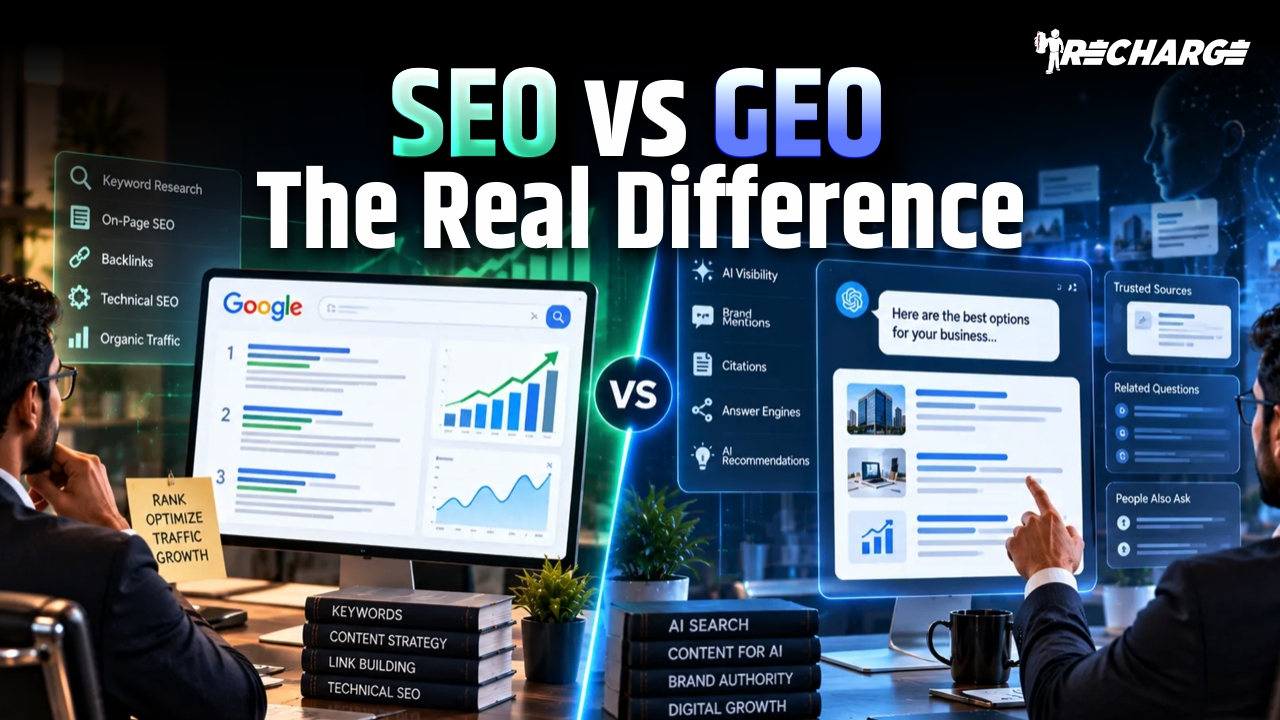
The biggest difference is that SEO focuses on helping your website rank in traditional search results, while GEO focuses on increasing your chances of being surfaced or cited by AI-powered search experiences like ChatGPT and Google AI Overviews.
SEO (Search Engine Optimisation) improves your website’s visibility in search engines by making pages relevant, technically strong, and useful for users.
GEO (Generative Engine Optimisation) focuses on making your content easier for generative AI systems to understand, trust, and reference when answering questions.
The relationship looks like this:
| SEO | GEO |
| Traditional Google rankings | AI-generated answers |
| Organic search traffic | AI search visibility |
| Keyword optimisation | Context and entity optimisation |
| Search intent | Conversational intent |
| Website clicks | Citations and mentions |
The important thing to remember is that GEO doesn’t replace SEO. Instead, it builds on many of the same quality signals.
What is Generative Engine Optimisation (GEO)?
Generative Engine Optimisation is the process of improving how your brand and content appear in AI-powered search experiences.
Instead of only targeting keyword rankings, GEO helps your content become useful enough for AI systems to reference when generating answers.
For example, someone might ask:
“What’s the best marketing strategy for a startup?”
Rather than listing ten websites, ChatGPT or Google AI Overviews may combine information from several trusted sources into one response.
Your goal is to become one of those trusted sources.
Effective generative search optimisation usually involves:
- Original content
- Clear explanations
- Strong topical authority
- Trustworthy information
- Good website structure
- Helpful internal linking
Businesses exploring long-term AI visibility often combine GEO with broader digital marketing strategies rather than treating it as a separate tactic. You can see how that fits into a full-service approach on the Recharge Studio website .
AEO and GEO are related, but they are not the same
Another term that’s becoming popular is AEO, which stands for Answer Engine Optimisation.
If you’ve searched for what is AEO or AEO meaning, the easiest way to understand it is this:
- SEO helps people find your website.
- AEO helps answer engines deliver direct answers.
- GEO helps generative AI build better responses using trustworthy information.
Think of them as three connected layers.
| Optimisation | Main Goal |
| SEO | Rank webpages |
| AEO | Answer questions directly |
| GEO | Improve AI-generated visibility |
For businesses, this means your content should answer questions clearly before expanding into detailed explanations.
That’s one reason conversational content performs better in modern search experiences.
Businesses still need SEO because AI search depends on strong foundations
Some marketers believe AI SEO has replaced traditional optimisation.
It hasn’t.
Google’s AI-powered search experiences continue to rely on many of the same quality signals that support regular Search visibility. Good technical SEO, crawlable pages, helpful content, and clear site structure still matter.
Start with the basics.
Make sure your website has:
- Fast loading pages
- Mobile-friendly design
- Clear heading structure
- Internal linking
- Indexable pages
- Helpful content
- Logical navigation
When these foundations are strong, AI systems have a much easier time understanding your website.
For example, if someone reads about generating business enquiries, they should naturally discover relevant examples through connected content like Recharge Studio’s Lead Generation portfolio rather than reaching a dead end.
GEO works best when your content demonstrates real expertise
One of the biggest ranking factors in AI search is credibility.
AI systems already have access to thousands of similar articles. They don’t need another generic blog repeating basic advice.
Instead, they reward content that offers something genuinely useful.
That means including:
- Real campaign insights
- Practical examples
- Updated information
- Original observations
- Clear explanations
- Trustworthy references
For example, instead of writing:
“Social media helps businesses grow.”
Explain how combining paid advertising, organic content, and conversion-focused landing pages improved results for a business.
That kind of practical experience strengthens E-E-A-T signals and improves overall content quality.
A connected content strategy also helps. Businesses interested in improving brand visibility can explore how Social Media Marketing works alongside broader digital campaigns instead of treating every channel separately.
SEO and GEO work better together than apart
The smartest businesses aren’t choosing between SEO vs GEO.
They’re combining both.
A practical strategy looks like this:
Continue investing in SEO
- Improve technical performance.
- Build topical authority.
- Strengthen internal linking.
- Optimise important service pages.
- Publish useful content consistently.
Add GEO-friendly improvements
- Answer real customer questions.
- Use conversational language.
- Build entity-based content.
- Include original insights.
- Make information easy to understand.
This combination improves visibility across Google Search, ChatGPT, Google AI Overviews, Bing Copilot, and other AI-powered search experiences.
Businesses running campaigns across multiple channels often see stronger results when content, paid marketing, and brand messaging work together, similar to Recharge Studio’s Multi-Channel Campaign approach .
The future belongs to businesses that optimise for both people and AI
Search is no longer limited to one platform.
Customers might discover your brand through Google Search, ask ChatGPT for recommendations, compare answers in Perplexity, and only then visit your website.
That’s why the question isn’t whether GEO will replace SEO.
The better question is:
How can your content become valuable wherever people search?
The businesses that win in AI search are usually the same ones creating trustworthy, helpful, and experience-driven content consistently.
If you’re planning your next SEO strategy or want to prepare your website for AI-powered search, you can contact Recharge Studio or book a meeting to discuss practical ways to improve long-term search visibility.
Conclusion
The debate around SEO vs GEO doesn’t have a single winner because both play different roles. SEO helps people discover your website through traditional search, while Generative Engine Optimisation improves how AI systems understand and surface your content.
As AI-powered search continues to grow, businesses don’t need to abandon SEO. They need to strengthen it while creating content that’s useful enough for AI to trust.
The best long-term strategy is simple: create original content, build authority, maintain strong technical SEO, and optimise for real conversations-not just keywords.
FAQs
1. What does GEO stand for?
GEO stands for Generative Engine Optimisation. It focuses on improving how websites and brands appear in AI-generated search experiences like ChatGPT, Google AI Overviews, and other conversational search platforms.
2. What is the difference between SEO and GEO?
SEO improves rankings in traditional search engines, while GEO helps AI systems understand and potentially reference your content when generating answers. Both rely on helpful content, technical quality, and trust.
3. What is AEO?
AEO means Answer Engine Optimisation. It focuses on creating content that answers user questions clearly so answer engines can present direct responses more effectively.
4. Can SEO and GEO work together?
Yes. The strongest strategy combines traditional SEO with GEO-friendly content. Technical optimisation, topical authority, conversational content, and real expertise work together across both search experiences.
5. How do I optimise for ChatGPT and Google AI Overviews?
Focus on original content, clear answers, strong internal linking, technical SEO, trustworthy information, and topical authority. These fundamentals help improve visibility across both traditional and AI-powered search.
How to Improve Your Website’s SEO Health Score in 2026

If you’ve ever felt confused about why your website isn’t ranking despite good content, don’t worry you’re not alone. Many Indian businesses, from IT solutions providers to online retailers, face the same challenge. The truth is, Google looks at your website’s overall “SEO health score” before deciding where you should appear.
Think of it like a fitness score for your website. If the technical side is weak, even the best content won’t perform. The good news? Improving your SEO health score in 2026 is easier when you focus on the right areas. Let’s break it down in a simple, practical way.
1. Fix the Basics: Site Speed, Mobile-Friendly Layout & Clean Structure
A healthy website begins with strong foundation work. Google wants users to have a smooth experience, so your site must load fast, look good on every device, and follow a clean structure.
Many brands approach an SEO agency in India only after struggling with slow pages or high bounce rates. But the fix often lies in small improvements compressing images, removing outdated scripts, simplifying navigation, and choosing a reliable hosting service.
You can check how agencies like Recharge Studio approach such improvements through their SEO & optimization work here:
Even tiny adjustments can increase your health score instantly.
2. Build Content That Solves Real Questions
Your SEO health score isn’t just about technical fixes. Google rewards websites that answer real questions quickly and clearly.
If you’re running an SEO company in India or a fast-growing startup, take a moment to see what your customers search before choosing service providers. Write content around those pain points FAQs, small how-to guides, short explainers, and even personal experience-based blogs.
The best content today is simple, honest, and helpful.
For inspiration on storytelling and value-driven content, explore the main site:
Good content builds trust. Trust builds ranking.
3. Strengthen Your Internal & External Link Structure
Search engines treat your website like a network. If your pages don’t link to each other properly, the site loses authority.
Create natural internal linking between related pages. And whenever you publish something new, link it from older high-performing pages.
External links also matter Google likes when you reference trusted sources.
If your business depends heavily on online visibility, consulting a local SEO agency can help you identify gaps. You can explore real examples of link-supporting campaigns here:
This kind of structured linking plays a huge role in boosting your SEO health score.
4. Maintain a Clean Technical Setup No Broken Links, No Duplicate Pages
One broken link can hurt user experience. Ten broken links can hurt your ranking.
In 2026, Google’s crawlers are smarter and stricter. Websites with duplicate content, broken URLs, or redirect chains lose points.
Make it a monthly habit to run a simple technical audit. Fix:
-
404 pages
-
Duplicate meta tags
-
Redirect loops
-
Unnecessary old pages
-
Orphan pages (pages without links)
Brands focused on structured digital growth often use expert services like these:
Their process shows how technical fixes support better rankings in the long run.
5. Use Social Signals & Brand Visibility to Support SEO Health
While social media doesn’t directly control ranking, it boosts your brand signals and helps Google understand your authority.
A strong presence on platforms like Instagram, LinkedIn, and YouTube sends quality traffic back to your website, improving:
-
Click-through rate
-
Engagement
-
Return visits
-
Session time
When these numbers rise, your health score improves too.
You can take a look at some of the social-led digital marketing strategies here:
These campaigns show how visibility and SEO work hand in hand.
6. Don’t Ignore On-Page SEO It Still Makes a Big Difference
Even in 2026, on-page SEO remains a strong pillar. Simple things like:
-
Writing clear meta titles
-
Adding natural keywords
-
Using alt tags
-
Writing honest descriptions
-
Breaking content into clean sections
…can dramatically improve the health of your website.
If you’re working with an affordable SEO agency in India, make sure they focus on on-page basics before jumping into advanced tactics.
If you ever feel unsure where to begin, a quick consultation can help.
7. Measure Your Progress Regularly
SEO is not a one-time task it’s like maintaining health through regular check-ups.
Keep an eye on your:
-
Core Web Vitals
-
Page load time
-
Organic traffic
-
Click-through rates
-
Ranking improvements
-
Indexed pages
If you need expert help, you can always reach out directly:
A trained team can guide you with a clear roadmap, whether you need heavy optimization or just minor upgrades.
Conclusion
Improving your SEO health score in 2026 isn’t about chasing complicated tricks. It comes from a mix of strong technical setup, meaningful content, clean linking, and consistent monitoring. When your website is healthy, Google trusts it and that trust turns into higher rankings, better traffic, and more conversions.
You can explore more SEO-friendly solutions and real case studies on Recharge Studio’s website to get a clearer picture of what works best for your business.
Read Also: How to Build Backlinks That Actually Improve Google Ranking
- Published in SEO
How to Build Backlinks That Actually Improve Google Ranking

Everyone wants to rank higher on Google. But here’s the truth even the most beautiful website or best-written blog won’t climb up the rankings without one key ingredient: backlinks. Think of backlinks as digital word-of-mouth every time another website links to yours, Google takes it as a vote of trust. But not all backlinks are created equal. If you want links that truly boost your ranking, you need to focus on quality, not quantity.
Let’s understand how businesses, from digital marketing companies to IT solutions providers, can build backlinks that genuinely make a difference.
1. Start with Valuable, Link-Worthy Content
The easiest way to earn backlinks is by giving people something worth linking to. When your content solves real problems, others will naturally want to reference it.
For example, if you run an IT solutions company, you could write practical blogs about common cybersecurity issues or emerging tech tools. If your content educates or helps decision-makers, you’ll attract natural backlinks from blogs, forums, and even news sites.
You can check how Recharge Studio approaches this their strategy revolves around creating content that’s visually appealing, informative, and relevant to both B2B and B2C audiences. This balance keeps people coming back, while also building strong backlink potential.
Tip: Mix formats use infographics, videos, and short explainers. People love linking to content that’s easy to understand and quick to share.
2. Collaborate with Industry-Relevant Websites
Networking plays a big role in link-building. Reach out to other businesses, bloggers, and digital media websites that share your audience base.
For instance, a digital marketing agency in Indore might collaborate with an IT solutions firm for a joint blog on digital transformation or AI marketing trends. Both brands benefit you exchange backlinks, reach new audiences, and build authority.
You can see this approach in action through Recharge Studio’s social media marketing campaigns, where collaborations often lead to organic mentions and backlinks from influencer pages and partner brands.
When you collaborate, make sure both sides bring value. Avoid mass link swaps or irrelevant backlinks, as Google easily detects and devalues those.
3. Guest Posting the Smart Way
Guest posting isn’t dead it just needs to be done right. Writing for other websites gives you a chance to reach fresh audiences while earning credible backlinks.
If you’re a digital marketing company offering SEO services, target blogs or online magazines that cover topics like branding, tech, or entrepreneurship. Write content that genuinely helps their readers not just something filled with keywords.
Within your guest post, you can naturally link back to a case study or service page on your own site. For example, link to your multi-channel campaign work from Recharge Studio’s portfolio section when you mention successful integrated marketing strategies.
Remember: guest posting is about building relationships and authority, not just collecting links.
4. Turn Your Work into Shareable Case Studies
Case studies work like hidden gold for backlinks. Businesses and marketers love real-world examples that show measurable results.
If you’ve delivered great results through your digital marketing solutions, showcase it in a detailed yet easy-to-read case study. Add visuals, numbers, and a strong narrative.
You can take inspiration from Recharge Studio’s lead generation portfolio it highlights specific strategies and results, making it both educational and shareable. Other marketers or media blogs often link to such examples when discussing marketing trends or success stories.
The goal is to make your success stories so authentic and useful that others want to reference them.
5. Get Listed in the Right Local and Industry Directories
For businesses targeting specific regions say, you’re offering digital marketing in Indore or looking for IT solutions near me local directories can be a powerful yet underrated backlink source.
List your business on trusted directories, Google Business Profile, Clutch, and industry-specific portals. These links might not bring heavy referral traffic, but they strengthen local SEO and credibility.
Many small and medium Indian businesses grow this way especially those combining online visibility with smart local networking.
If you’re not sure how to start building your backlink structure, you can book a meeting with experts who specialize in optimizing backlink strategies for regional and national markets.
6. Promote Your Content Actively
Even the best blog or case study won’t get backlinks unless people see it. Promotion is where most businesses fall short.
Once you publish something valuable, share it across platforms LinkedIn, WhatsApp groups, newsletters, and niche online communities. You can even use paid ads to give it an initial push.
For example, a digital marketing agency near me that posts a strong educational blog about SEO tools can boost it through small LinkedIn ads or email campaigns. That exposure can attract organic backlinks from people who discover and quote it later.
Check out Recharge Studio’s approach to lead generation campaigns they combine creative promotion with precise targeting to increase both visibility and link opportunities.
7. Keep Monitoring and Refining Your Backlink Strategy
Building backlinks is not a one-time effort. Keep tracking which sources are driving actual results. If you find low-quality or spammy backlinks, disavow them.
At the same time, look for patterns are certain types of content or partnerships giving better backlinks? Double down on those.
If you need help structuring a consistent backlink and SEO plan, feel free to contact the team at Recharge Studio. They specialize in long-term digital marketing strategies that bring measurable growth.
Conclusion
Strong backlinks are built, not bought. When your content adds value, your collaborations feel genuine, and your strategies stay consistent, Google notices.
Whether you’re an IT solutions company or a digital marketing agency, focus on authenticity, quality, and trust. Over time, those links will not only improve your ranking but also build your brand’s reputation across the web.
You can explore more about SEO and digital growth solutions on Recharge Studio’s website.
Read Also: How to Generate Qualified Leads Using Paid & Organic Channels
- Published in SEO
How to Use SEO & Paid Ads Together for Explosive Growth

When SEO Meets Paid Ads – The Perfect Growth Duo
In the fast-paced digital marketing landscape, most brands treat SEO and paid advertising as two separate worlds. One is slow and steady, the other fast and flashy. But when you blend them strategically, they can create explosive business growth. The smartest marketing managers, business professionals, and marketing heads are now realizing that this combination can deliver sustainable visibility and immediate conversions — the ultimate win-win.
If your brand is ready to go beyond average results and dominate the digital space, here’s your roadmap.
1. The Synergy Between SEO and Paid Ads
Think of SEO as the strong foundation of your online presence — it builds credibility, drives organic traffic, and ensures your brand ranks for the right keywords. Meanwhile, paid ads give you speed, allowing you to appear instantly for high-intent searches.
By combining both, your marketing team can test keywords with paid campaigns and later integrate the best-performing ones into your SEO strategy. This reduces guesswork and ensures your content strategy is built on real performance data.
If you’re looking for professional support in planning this kind of integrated approach, check out Recharge Studio — experts in aligning SEO and paid media for long-term success.
2. Use Paid Ads to Amplify SEO Insights
Your Google Ads or social media ads can give valuable insights about which keywords convert best, what headlines attract clicks, and what offers users respond to most. This data can then refine your SEO content and help you focus on the right audience segments.
For instance, when you run campaigns through Multi-Channel Campaigns, you can analyze engagement patterns and use that intelligence to improve organic performance.
When done right, SEO and PPC (Pay-Per-Click) don’t compete — they complement each other beautifully.
3. Dominate Search Results — Twice!
Imagine your brand showing up twice on Google: once through an ad and again organically. This not only increases your visibility but also boosts trust. Users tend to click more on brands that appear multiple times on the same search page — they feel more legitimate and credible.
Partnering with an experienced SEO agency in India can help you achieve this double visibility through a smart combination of on-page optimization and targeted ad placements.
4. Smart Budget Allocation for Maximum ROI
One of the biggest challenges in digital marketing is budget management. By studying your SEO performance, you can identify high-converting pages and support them with paid promotions. Similarly, you can reduce ad spend for keywords where you already rank organically.
This creates a balanced ecosystem — organic traffic sustains your visibility, while paid ads give you quick wins. Whether you need local SEO agency expertise or complete multi-channel marketing support, you can always book a meeting with the team at Recharge Studio to explore customized solutions.
5. Reinforce Brand Authority Through Cross-Channel Visibility
When your audience sees your brand across multiple touchpoints — search results, social feeds, and targeted ads — it builds trust. Consistency in messaging across these channels is crucial for brand authority.
If you want to amplify this strategy further, explore Social Media Marketing campaigns that align with your SEO tone and paid ad visuals. It’s this consistent, omnichannel presence that gives brands the edge in 2026’s competitive market.
6. Measure, Refine, Repeat
The real power of combining SEO and paid ads lies in continuous optimization. Use analytics to compare organic vs. paid conversions, keyword overlaps, and audience behavior.
Platforms like Lead Generation solutions from Recharge Studio can help track end-to-end performance, making it easier for marketing managers to make informed decisions.
If you ever feel stuck in campaign strategy or need to discuss a custom brand campaign, you can directly contact the experts for tailored advice.
Conclusion: Integration is the Future of Digital Growth
SEO alone is powerful, and paid ads deliver speed — but together, they create unstoppable momentum. In 2026, the brands that will truly stand out are those that understand this synergy and execute it smartly.
So, whether you’re a marketing head refining your funnel, a business professional exploring performance marketing, or a marketing enthusiast keen to scale your reach — the key lies in integration.
And if you want to implement a custom strategy designed for growth, Recharge Studio — one of the best SEO agencies in India — can help you merge your SEO and ad strategies for lasting impact.
Read Also: How to Build a Powerful Brand Identity That Stands Out in 2026
- Published in SEO
SEO in 2026: How to Rank High Despite AI Search Updates

Search is evolving faster than ever. But this time, it’s not a simple Google update — it’s a full-blown transformation. With AI-powered search experiences like Google’s SGE (Search Generative Experience) changing how users find and consume content, brands must rethink their SEO game.
In 2026, ranking high will no longer depend solely on keywords or backlinks — it will depend on trust, authority, and human value. Whether you’re a marketing manager, a digital enthusiast, or a business professional, adapting to AI-driven SEO trends will decide whether your brand thrives or disappears.
Let’s dive into how you can stay ahead with a future-ready SEO strategy.
1. AI Search Has Changed the Rules — Here’s How
AI-powered search engines now summarize answers directly, pulling data from multiple sources instead of displaying a list of links. This means your website’s visibility depends on how useful, structured, and authentic your content is.
Your goal in 2026: create content that AI wants to reference. That means accuracy, clarity, and depth matter more than ever.
To prepare for this change, partner with an integrated SEO agency India like Recharge Studio, which helps brands build future-proof SEO ecosystems aligned with AI-based search models.
2. Create Human-First, AI-Friendly Content
The era of robotic keyword stuffing is over. AI now understands context, tone, and user intent — and rewards content that sounds human.
Key Tips:
-
Write naturally and conversationally.
-
Include real data, experiences, and examples.
-
Structure your pages with schema and semantic tags for better AI readability.
That’s why the best SEO agency in India focuses on blending emotional storytelling with technical optimization — ensuring both humans and machines connect with your message.
3. Build Authority Through Experience and Trust
Google’s E-E-A-T (Experience, Expertise, Authoritativeness, and Trustworthiness) now plays a major role in rankings.
Share who you are and what you’ve done. Add author bios, case studies, and genuine testimonials. AI systems pick up on credibility signals to decide which sources are reliable enough to cite in AI-generated answers.
Explore Recharge Studio’s Lead Generation Portfolio to see how authentic, result-driven storytelling strengthens both brand authority and visibility.
4. Optimize for Conversational and Voice Search
With AI and voice assistants leading the future, queries sound more natural — like “Which affordable SEO agency India offers full-service solutions?”
To capture this traffic:
-
Use question-based subheadings (like this one).
-
Focus on long-tail keywords and natural phrases.
-
Provide direct, clear answers in your content.
If you’re looking for the best SEO agency near me to tailor your website for voice and conversational search, Book a Meeting with Recharge Studio’s SEO experts today.
5. Leverage Social Signals and Engagement
Social activity increasingly influences how AI measures relevance and trust. When your posts perform well across platforms, it signals authority to search engines.
Combine SEO with a strong social media plan for consistent messaging and audience engagement.
To see this synergy in action, explore Recharge Studio’s Social Media Marketing Portfolio — where SEO strategy and social storytelling come together seamlessly.
6. Local SEO Will Matter More Than Ever
Even in a global AI-driven world, local visibility remains powerful. Searches like “local SEO agency” or “best SEO agency near me” still drive high-conversion traffic.
Local SEO checklist for 2026:
-
Keep your Google Business Profile updated.
-
Use location-based schema markup.
-
Collect genuine customer reviews.
If you want to dominate your region’s search results, Contact Recharge Studio — an affordable SEO agency India helping brands connect locally and scale globally.
7. Integrate SEO into Your Complete Marketing Ecosystem
In 2026, SEO works best when it’s not isolated. It must align with your content marketing, paid ads, and social strategy.
An integrated SEO agency India ensures every campaign — from blog posts to lead funnels — works toward the same goal: visibility and conversions.
To see how full-funnel SEO integration drives business growth, visit Recharge Studio’s Lead Generation Projects.
Final Thoughts
SEO in 2026 isn’t dying — it’s evolving. AI search is smarter, but it still depends on human creativity, relevance, and trust.
The brands that will win this race are those that speak like humans, think like strategists, and act like innovators.
If you’re ready to redefine your SEO strategy and rise above AI’s disruption, partner with Recharge Studio — the best SEO agency that blends human storytelling with next-gen optimization to help your business lead the future of search.
Read Also: How to Create Facebook Ad Campaigns That Convert in 2026
- Published in SEO
How SEO Transforms Digital Visibility

In today’s digital-first marketplace, visibility is everything. You might have the most innovative product or the most compelling service, but if your customers can’t find you online, your growth potential is limited. This is where SEO (Search Engine Optimization) plays a game-changing role. It is not just about ranking higher on search engines—it’s about creating trust, building authority, and turning visibility into conversions.
For marketing managers, business leaders, and marketing enthusiasts, understanding how SEO transforms brand presence is no longer optional—it’s essential.
From Search to Connection
When a user types “seo services near me” or “professional seo services,” they’re not just browsing; they’re looking for a solution. Appearing at the right time with the right message makes the difference between being noticed and being ignored.
By partnering with a search engine optimization agency, businesses can position themselves directly in front of their audience. The key isn’t just ranking for keywords but ranking for the right ones—those that match user intent.
Why SEO is a Long-Term Investment
Unlike paid ads that stop once the budget dries up, SEO compounds over time. Each optimized page, backlink, and keyword builds authority and credibility. This is why top brands, from startups to enterprises, lean on search engine optimization services to ensure consistent growth.
Companies offering digital marketing services understand that SEO is the backbone of online success. It creates organic visibility that continues to deliver results long after campaigns are launched.
Building Trust with Optimized Content
Content may be king, but without SEO, even the best content remains invisible. Blog posts, landing pages, and product descriptions need optimization to reach their full potential.
A solid strategy, including ecommerce seo services, ensures that content doesn’t just attract visitors but converts them. For example, integrating SEO with lead generation makes campaigns more targeted and powerful.
SEO Beyond Keywords
Modern SEO goes beyond stuffing keywords into text. It involves technical aspects like site speed, mobile responsiveness, and user experience. A search engine optimization company helps streamline these elements so that both search engines and users have a seamless experience.
Pairing this with social media marketing builds a holistic digital presence where every channel supports the other.
Local and Global Reach
Whether you’re a global brand or a local business, SEO adapts to your goals. With local SEO services, businesses can capture nearby audiences searching for immediate solutions, while global campaigns can expand reach across borders.
For businesses aiming to rebrand or reposition, services like brand creation & rebranding combined with SEO help them align their new identity with digital visibility.
Measurable and Scalable Results
One of SEO’s greatest strengths is measurability. Analytics reveal what’s working, what needs improvement, and where opportunities lie. Unlike guesswork, SEO delivers data-driven insights that guide smarter marketing investments.
Tools and strategies from a search engine optimization agency ensure scalability—whether it’s reaching new markets, targeting niche segments, or optimizing for voice and AI-driven searches.
Taking Action
The power of SEO lies in execution. To stay competitive, businesses must act now. You can book a meeting with experts who understand the evolving SEO landscape or contact us to create a customized roadmap.
Whether you need ongoing optimization, best SEO services for specific campaigns, or a complete digital visibility strategy, the right approach ensures your brand isn’t just online—it’s seen, trusted, and chosen.
Final Thoughts
SEO is no longer just about climbing rankings—it’s about creating meaningful connections and driving growth. For modern businesses, investing in professional SEO services means amplifying visibility, improving credibility, and turning traffic into loyal customers.
If your brand is ready to step into the spotlight, now is the time to transform digital visibility with SEO.
Read Also: Amplify Your Marketing with Music & Jingles
- Published in SEO
How Roadshows Boost Brand Awareness

In today’s competitive market, where consumers are flooded with ads and digital campaigns every second, businesses are constantly searching for impactful ways to stand out. Among the most dynamic strategies, roadshows have proven to be a powerful tool to elevate brand awareness, engage audiences, and create memorable experiences. Unlike static advertisements or one-off campaigns, roadshows bring your brand directly to people, sparking connections that linger long after the event.
Roadshows: Beyond Traditional Marketing
A roadshow is not just a promotional event—it’s a moving brand story. Imagine taking your message out of the boardroom or screen and delivering it face-to-face in high-energy settings. Roadshows provide a rare opportunity for businesses to showcase products, demonstrate services, and create personal touchpoints that digital platforms often lack. This interactive form of marketing generates curiosity, builds credibility, and helps foster trust.
For businesses aiming to create or refresh their brand identity, roadshows can complement initiatives like brand creation and rebranding by ensuring that new messaging and visuals are experienced firsthand.
Why Roadshows Excel in Building Awareness
1. Tangible Experiences
While digital campaigns rely heavily on visuals and messaging, roadshows deliver sensory experiences. From product demos to branded merchandise giveaways, attendees are more likely to remember your brand because they interacted with it in real life. Companies can even strengthen this engagement with thoughtfully designed custom-branded merchandise that becomes a lasting reminder.
2. Targeted Engagement
Unlike mass media campaigns that spread a wide net, roadshows allow you to take your message to specific regions, cities, or industry hubs. This strategic approach ensures your efforts are directed at the right people. Whether you are targeting decision-makers, partners, or potential clients, each roadshow stop becomes a micro-market tailored to your audience.
3. Amplified Word-of-Mouth
When people attend a roadshow and enjoy the experience, they don’t keep it to themselves. They talk, share on social media, and spread the word within their circles. This ripple effect extends your reach far beyond the attendees, making roadshows a cost-effective multiplier for awareness.
4. Boosting Lead Generation
Roadshows don’t just spread awareness—they also open doors for conversions. Collecting data, engaging prospects, and building a database of potential clients become seamless during these events. Businesses focusing on measurable outcomes can connect roadshows with tailored strategies like lead generation campaigns, ensuring the buzz translates into tangible results.
5. Humanizing the Brand
At the core of every successful brand lies trust. Roadshows humanize your brand by placing your team in front of real people. Conversations, face-to-face problem-solving, and interactive demos build authenticity. Unlike online ads, which are often perceived as impersonal, roadshows give your brand a voice and personality that resonates.
Integrating Roadshows into Your Marketing Mix
Roadshows should never operate in isolation. To maximize impact, they must integrate with other marketing channels. Pre-event digital promotion, live social media updates, and post-event follow-ups ensure that the energy of the roadshow extends beyond the event itself. Businesses can weave roadshows into larger brand campaigns or align them with strategic milestones like product launches, expansion drives, or rebranding exercises.
Additionally, incorporating elements of storytelling, gamification, and interactive booths can significantly enhance the recall value of each event. A thoughtfully crafted roadshow not only educates but also entertains, leaving participants eager to engage further with your business.
When Should Businesses Opt for Roadshows?
-
Launching a new product or service: First impressions matter. A roadshow helps generate buzz while offering audiences a hands-on experience.
-
Entering a new market: It’s the perfect way to introduce your business to new regions with cultural nuance and personal engagement.
-
Rebranding initiatives: Roadshows provide a platform to present your fresh identity directly to your target audience.
-
Relationship-building: Beyond sales, roadshows nurture partnerships and strengthen loyalty among stakeholders.
The Long-Term Payoff
While organizing roadshows requires investment and planning, the returns are invaluable. They not only deliver short-term visibility but also foster long-term brand loyalty. Each event strengthens your brand’s positioning as approachable, credible, and people-focused—qualities that are increasingly vital in today’s competitive landscape.
If you’re considering making roadshows part of your strategy, working with experienced partners like Recharge Studio can ensure flawless execution—from ideation and design to on-ground activation. Whether your goal is boosting awareness, capturing leads, or enhancing customer relationships, their expertise helps transform roadshows into growth engines.
Conclusion
Roadshows are more than just events—they’re opportunities to breathe life into your brand story. They take marketing from passive viewing to active participation, making your business unforgettable in the eyes of your audience. By combining creativity, strategy, and personal engagement, roadshows create a brand presence that resonates long after the event concludes.
Ready to make your next roadshow a success? Start planning today and connect with Recharge Studio’s experts to bring your brand closer to the people who matter most.
Read Also: Web Design Trends to Watch in 2025.
- Published in SEO
10 Proven SEO Strategies to Rank Higher
1. Mastering Keyword Research with Intent
Keyword research is the backbone of any SEO strategy, but the real magic happens when you focus on search intent. Instead of simply targeting high-volume keywords, dig into why users are searching. Keywords with clear intent, whether informational, navigational, or transactional, help align content with user expectations, boosting your relevance to both readers and search engines.
2. Optimize for Voice Search
With the growing use of voice assistants, optimizing for voice search has become non-negotiable. Voice search queries tend to be conversational and question-based, so try structuring your content in a natural tone, using longer-tail keywords. This will help capture traffic from people asking questions, especially on mobile and smart home devices.
3. Leverage Long-Form Content
Search engines favor well-researched, in-depth content because it demonstrates expertise and provides more value. Posts ranging from 1,500 to 2,500 words tend to perform exceptionally well. But remember, length alone isn’t enough—ensure every sentence adds value. Break up text with headers, bullet points, and visuals to keep readers engaged.
4. Create Compelling Meta Titles and Descriptions
A well-crafted meta title and description can significantly improve click-through rates, which indirectly boosts rankings. Aim for titles that are concise yet enticing, and descriptions that offer a sneak peek into what readers will gain. Include your target keyword naturally but avoid stuffing—it should read seamlessly.
5. Enhance Your Site’s Speed and Mobile-Friendliness
Slow, clunky websites drive visitors away, which signals to search engines that your site might not be user-friendly. Use tools like Google PageSpeed Insights to diagnose and improve your loading times. Additionally, a mobile-friendly design isn’t optional; it’s mandatory. A responsive design ensures your site is accessible and functional on any device.
6. Optimize for Featured Snippets
Featured snippets (often called “position zero”) are quick answers to search queries that Google displays at the top of results. To optimize for these, structure content with clear, concise answers that directly respond to common questions. Lists, tables, and short paragraphs can increase the chance of your content being selected as a featured snippet.
7. Utilize Internal Linking Strategically
Internal linking strengthens the overall structure of your site and helps search engines better understand each page’s relevance. Link to related articles, services, or product pages in a way that adds context. This not only aids in user navigation but also spreads link equity throughout your site, boosting rankings across multiple pages.
8. Invest in High-Quality Backlinks
Quality backlinks remain one of the strongest signals of authority to search engines. Focus on earning links from reputable sites in your industry rather than accumulating links en masse. Building partnerships, guest blogging, and creating valuable resources can organically attract backlinks that elevate your site’s authority.
9. Optimize Image SEO
Images can attract a surprising amount of traffic when optimized properly. Ensure each image has descriptive alt text and a file name that aligns with the image’s content. Additionally, compress images to avoid slowing down your site and use appropriate file types (such as JPEG for photos and PNG for graphics) to maintain quality without bloating load times.
10. Analyze and Adapt Regularly
SEO is a dynamic field; what worked last year may not work today. Make regular SEO audits part of your strategy. Monitor key metrics such as bounce rates, click-through rates, and organic traffic to see where you can improve. Stay updated with Google’s algorithm changes and adapt accordingly to maintain or improve your rankings.
Recharge Trend Setter is a leading advertising agency in India that can help you grow your business and reach your target audience. We offer a wide range of services, such as branding, marketing, advertising, event management, AV production and all kinds of IT services. We have a team of experts who are passionate about their work and deliver results that exceed your expectations. We have worked with some of the most reputed brands in India and abroad. If you want to take your business to the next level with Recharge Trend Setter, don’t hesitate to contact us today. Recharge Trend Setter is the ultimate partner for your brand success. Book a meeting with our team now and get ready to recharge your brand!
- Published in SEO
- 1
- 2