
Leading ATL & BTL Branding Agency in Indore, Madhya Pradesh
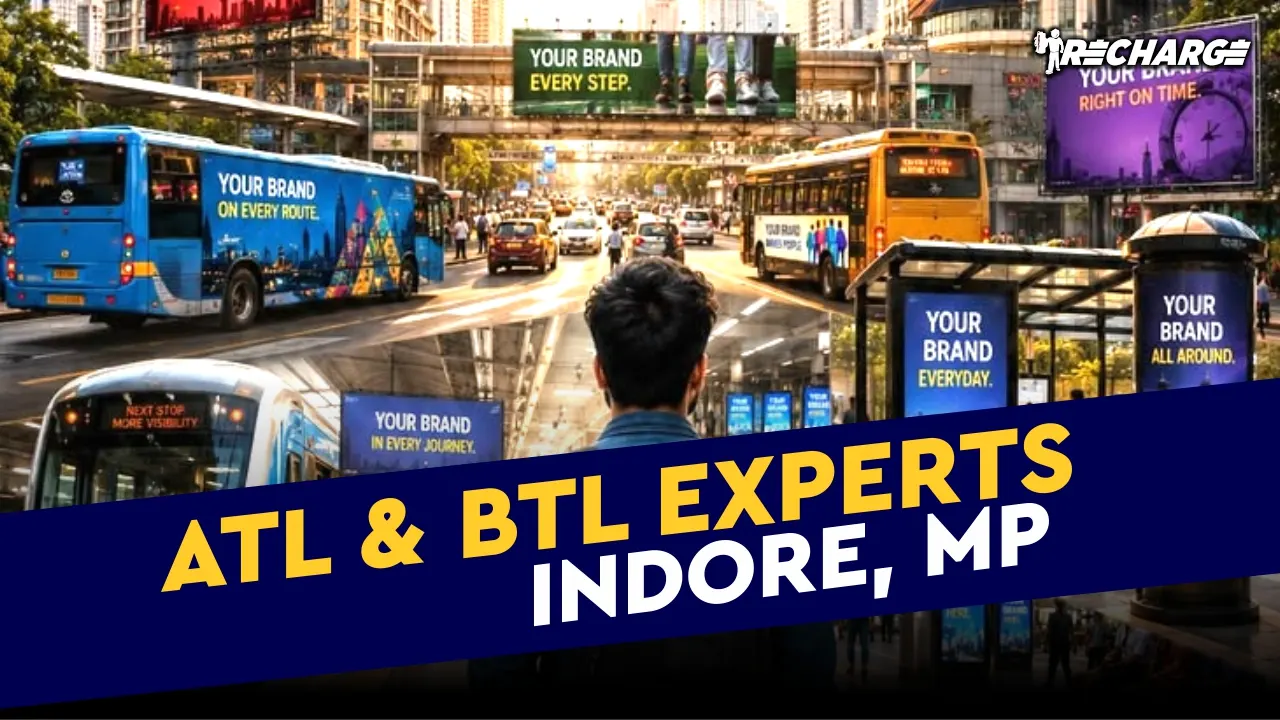 A strong brand needs more than a good logo or a creative advertisement. It needs the right message, the right audience, the right communication channels and consistent experiences across every customer touchpoint.
That is where ATL and BTL marketing come into play.
Recharge Trendd Setter is a creative digital marketing agency delivering bold branding and digital solutions, with capabilities spanning digital marketing, experiential and activations, brand solutions and IT solutions. The agency’s website also highlights its work across brands, services and campaigns, reflecting a broader approach to building and promoting brands.
For businesses looking for an ATL & BTL branding agency in Indore, the focus should not simply be on running advertisements. A good agency should understand the brand, audience, market and business objective before deciding where and how the campaign should appear.
From mass-media advertising and outdoor branding to events, activations, customer engagement and digital campaigns, ATL and BTL can work together to create a more connected marketing strategy.
What Is ATL Marketing?
ATL stands for Above-the-Line marketing. It generally refers to advertising designed to reach a broader audience through mass-media and high-reach channels.
Common ATL marketing channels include:
- Television advertising
- Radio advertising
- Newspaper advertising
- Magazine advertising
- Outdoor advertising
- Billboard and hoarding campaigns
- Transit media
- Print advertising
- Cinema advertising
- OOH advertising
The main purpose of ATL advertising is often to build awareness, visibility and broad audience reach.
For example, a company launching a new product across Madhya Pradesh may use outdoor advertising, radio, print or other mass-media channels to introduce the brand to a larger audience.
An ATL marketing agency in Indore can help businesses determine which channels make sense for their target market, campaign objective, location and budget.
ATL should not be treated as simply “putting an advertisement everywhere”. Media planning, creative communication, audience selection and campaign consistency all influence how effectively a brand is presented.
The American Marketing Association describes advertising as the placement of messages intended to inform or persuade a target audience, which reinforces why channel selection and communication strategy need to work together.
What Is BTL Marketing?
BTL stands for Below-the-Line marketing and generally focuses on more targeted, direct or experience-led promotional activities.
Examples include:
- Product sampling
- Roadshows
- Exhibitions
- Events
- Retail promotions
- In-store branding
- Point-of-sale marketing
- Trade promotions
- Direct marketing
- Customer activations
- Field marketing
- Promotional campaigns
- Experiential marketing
- Consumer engagement activities
A BTL marketing agency in Indore can help brands connect with audiences in more direct and interactive environments.
Imagine a new consumer brand entering the Indore market. Instead of relying only on outdoor advertising, the business could organise product sampling, retail activations, mall activities or an on-ground promotional campaign.
The customer gets an opportunity to experience the product or interact with the brand rather than simply seeing an advertisement.
That interaction can make BTL particularly useful when customer engagement, trials, local visibility or direct response is part of the campaign objective.
ATL vs BTL: What’s the Difference?
ATL and BTL are different approaches, but businesses do not necessarily have to choose one over the other.
| ATL Marketing | BTL Marketing |
| Focuses on broad reach | Focuses on targeted engagement |
| Television, radio, print and OOH | Events, activations, sampling and promotions |
| Builds wider awareness | Encourages direct interaction |
| Suitable for mass communication | Useful for specific audiences or locations |
| Often measured through reach and impressions | Can be measured through engagement, responses, participation and leads |
The strongest strategy depends on the business objective.
A national or regional awareness campaign may require significant ATL activity. A local product launch may benefit from BTL activations. In many situations, combining both can create a stronger marketing mix.
The American Marketing Association also distinguishes marketing strategy from individual advertising activities and describes campaigns as coordinated activities built around a common theme or objective.
Why Businesses Need ATL and BTL Marketing Together
Customers rarely interact with a brand through just one channel.
Someone may see a billboard on the way to work, hear the brand on radio, notice a social media advertisement and later encounter the same brand at a retail outlet.
When these touchpoints communicate a consistent idea, the campaign becomes easier to recognise.
This is why an ATL BTL integrated marketing campaign can be useful.
ATL can help create awareness at scale, while BTL can bring the brand closer to specific audiences through experiences and direct engagement.
For example:
ATL: Outdoor advertising across high-traffic areas in Indore.
BTL: A product activation at selected retail locations.
Digital: Social media and paid advertising supporting the campaign.
Branding: Consistent visual identity, messaging and campaign creative across all touchpoints.
This approach connects mass awareness with customer interaction instead of treating each marketing activity as a separate campaign.
ATL & BTL Branding Services in Indore
A professional ATL BTL branding agency in Indore should be capable of connecting strategy, creativity and execution.
Depending on the campaign, services may include:
ATL Advertising Services
- Media planning
- Media buying
- Outdoor advertising
- Billboard and hoarding campaigns
- Print advertising
- Radio campaigns
- Mass-media advertising
- Campaign creative development
- Brand awareness campaigns
BTL Marketing Services
- Brand activations
- Product sampling
- Roadshows
- Exhibitions
- Promotional events
- Retail branding
- In-store promotions
- Consumer engagement
- Field marketing
- Experiential campaigns
Branding Services
- Brand strategy
- Brand positioning
- Brand identity
- Brand messaging
- Corporate branding
- Visual identity
- Campaign concepts
- Creative communication
- Brand promotion
- Marketing communication
The right combination depends on the campaign rather than a fixed list of services.
Experiential & Activations
Recharge Trendd Setter: Creative Branding Meets Digital Solutions
Recharge Trendd Setter brings together creative thinking, branding and digital solutions for businesses that want their marketing to stand out.
The official Recharge Studio website describes the business as a “Creative Digital Marketing Agency Delivering Bold Branding & Digital Solutions” and highlights four broad areas: Digital Marketing, Experiential & Activations, Brand Solutions and IT Solutions.
Its positioning is centred on combining creativity, technology and data-driven thinking to build stronger connections between brands and their audiences. The website also reports work across 50+ brands, 25+ services, 70+ resources and 2,100+ campaigns.
That wider capability is useful because ATL and BTL campaigns rarely exist in isolation.
A campaign may need branding before launch, creative development during planning, on-ground execution during activation and digital communication before and after the campaign.
A connected team can help maintain consistency across those stages.
Choosing the Right ATL & BTL Branding Agency
When searching for the best ATL and BTL branding agency in Indore, businesses should look beyond the word “best”.
Evaluate the agency based on:
Understanding: Does the agency understand your business and audience?
Strategy: Can it connect campaign activities with your business objectives?
Creative capability: Can it develop communication that is distinctive and relevant?
Execution: Can it manage campaigns, activations and marketing deliverables effectively?
Integration: Can ATL, BTL, branding and digital activity work together?
Experience: Does the agency have relevant projects, campaigns or case studies?
Communication: Can the team clearly explain the campaign plan, deliverables and measurement approach?
A good agency should not recommend television, outdoor advertising, events or activations simply because they are available. Each channel should have a reason for being part of the campaign.
ATL, BTL and Digital Marketing: A Stronger Combination
Modern campaigns do not always fit neatly into traditional categories.
A business can combine ATL and BTL with:
- SEO
- Social media marketing
- Paid advertising
- Content marketing
- Lead generation
- Influencer marketing
- Website development
- Email marketing
- Conversion optimisation
For example, an offline activation can generate awareness while social media extends the conversation online. A landing page can capture enquiries, while paid advertising retargets interested users.
This is where a full-service advertising and digital marketing agency in Indore can provide value by connecting multiple channels around one campaign idea.
Recharge Trendd Setter’s broader digital and brand capabilities support this kind of integrated approach.
Final Thoughts
ATL and BTL marketing are not competing approaches that businesses must always choose between. They can serve different purposes within the same marketing strategy.
ATL can help a brand reach a broader audience and build awareness, while BTL can create targeted interactions, experiences and engagement. When combined with branding and digital marketing, these activities can create a more connected customer journey.
For businesses searching for an ATL & BTL branding agency in Indore, Madhya Pradesh, Recharge Trendd Setter offers a creative approach that connects branding, experiential activations and digital solutions.
The goal should not simply be to make a campaign visible. It should be to make the brand recognisable, relevant and memorable.
Frequently Asked Questions
What is ATL marketing?
ATL, or Above-the-Line marketing, generally refers to advertising designed for broad audience reach through channels such as television, radio, print and outdoor media. It is commonly used to build brand awareness and communicate a message at scale.
What is BTL marketing?
BTL, or Below-the-Line marketing, generally involves more targeted and direct promotional activities such as events, roadshows, product sampling, exhibitions, retail promotions and brand activations. It focuses strongly on direct audience interaction and engagement.
What is the difference between ATL and BTL marketing?
ATL generally focuses on broad reach and mass awareness, while BTL focuses more on targeted communication, interaction and activation. Businesses can use either approach or combine both depending on their campaign objectives.
Which is the best ATL BTL agency in Indore?
The right agency depends on your campaign requirements, target audience, budget and objectives. When comparing an ATL BTL agency in Indore, look at its strategic approach, creative capabilities, relevant experience, execution capabilities and ability to integrate branding with other marketing channels.
How does BTL marketing help businesses?
BTL marketing can help businesses engage customers through activities such as product demonstrations, sampling, exhibitions, roadshows, retail promotions and experiential activations. These activities can create opportunities for direct interaction with the target audience.
Can ATL and BTL marketing work together?
Yes. ATL can help create broad awareness while BTL can create more targeted customer interactions. Combining them with consistent messaging and digital marketing can help businesses create a connected campaign across multiple customer touchpoints.
Why choose an ATL BTL branding agency in Indore?
Working with an agency in Indore can be useful for businesses targeting customers in the city or across Madhya Pradesh. The agency can plan campaigns around relevant local audiences, media channels, events, retail environments and wider marketing objectives.
Work With Recharge Trendd Setter
If your business is planning a new brand launch, regional campaign, promotional activation or integrated marketing campaign, the right strategy should begin with your audience and business objective.
Recharge Trendd Setter combines creative branding and digital solutions with experiential and activation capabilities to help businesses build stronger connections with their audiences.
From ATL advertising and BTL marketing to brand solutions and digital marketing, the focus is on creating campaigns that have a clear purpose and fit the brand.
Disclaimer
Marketing results vary according to the business, target audience, campaign objective, market conditions, budget, creative execution and media strategy. No advertising or branding agency can guarantee a specific level of awareness, leads, sales or return on investment.
- Published in General
ATL vs BTL vs TTL Marketing: A Complete Comparison
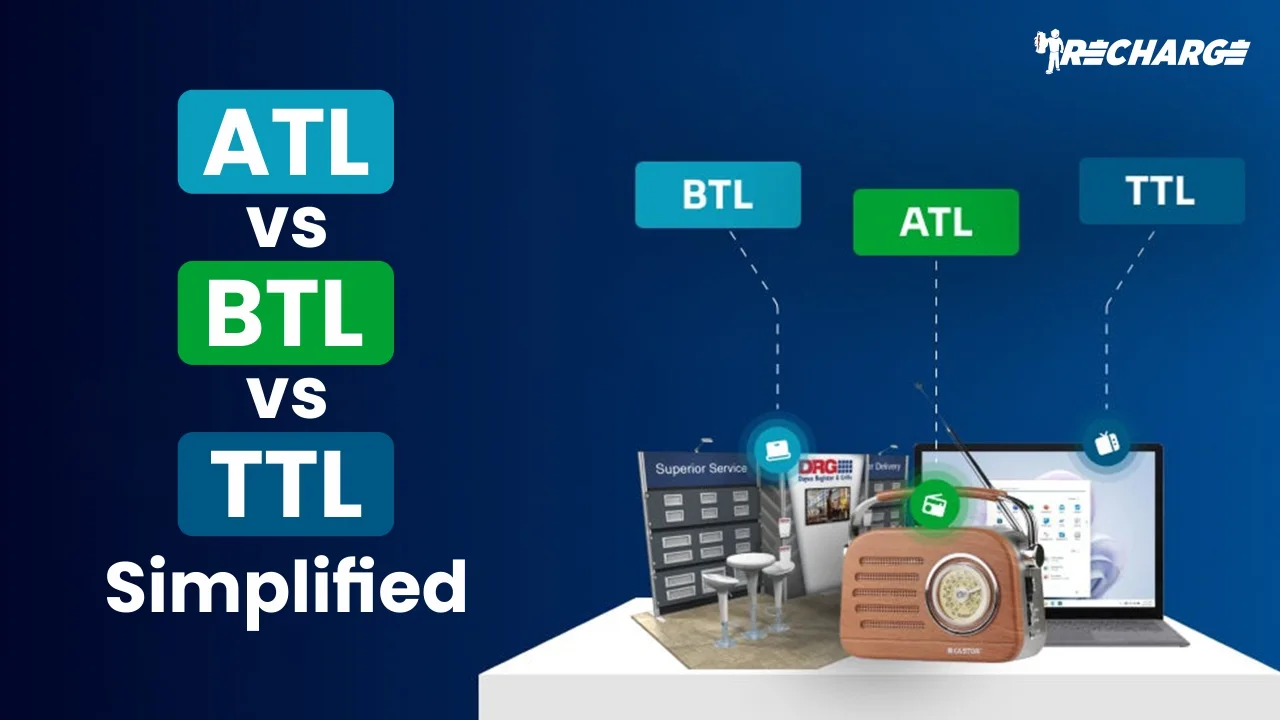
Choosing the right marketing approach is not simply about deciding where to advertise. Businesses need to understand who they want to reach, what they want to achieve and where customers are in their buying journey.
This is where ATL vs BTL vs TTL marketing becomes important. ATL, BTL and TTL represent three different approaches to marketing communication. Above The Line (ATL) focuses on reaching large audiences through mass media. Below The Line (BTL) focuses on targeted and direct customer engagement. Through The Line (TTL) combines both approaches to create a more integrated marketing strategy.
While the three methods have different strengths, modern businesses often use them together. The right mix can support brand awareness, customer engagement, lead generation and conversions across different stages of the marketing funnel.
What Is ATL Marketing?
ATL marketing, or Above The Line marketing, focuses on reaching a broad audience through mass media channels. The primary objective is generally to build brand awareness and create widespread visibility rather than target individual customers with highly personalised messages.
Common ATL marketing channels include:
- Television advertising
- Radio advertising
- Newspaper advertising
- Magazine advertising
- Billboard advertising
- Outdoor advertising
- Cinema advertising
For example, a consumer brand launching nationally may use television and outdoor advertising to introduce its product to millions of potential customers.
ATL can be particularly useful when a business wants to establish or strengthen brand recognition. However, because the audience is broad, measuring direct conversions can sometimes be more difficult than with highly targeted campaigns.
Contact Recharge Studio for : Creative Brand Solutions to Elevate Your Business Presence
What Is BTL Marketing?
BTL marketing, or Below The Line marketing, takes a more targeted approach. Instead of communicating with a mass audience, businesses focus on specific customer groups, locations or individuals.
BTL marketing examples include:
- Email marketing
- SMS marketing
- Trade shows
- Event marketing
- Product demonstrations
- Sampling campaigns
- Sales promotions
- Direct marketing
- Targeted advertising
BTL campaigns are often designed to encourage a specific response, such as making an enquiry, attending an event, trying a product or making a purchase.
For example, a company could run an in-store product demonstration or send a targeted promotional campaign to existing customers. This makes BTL particularly useful for customer engagement, lead generation and direct response marketing.
What Is TTL Marketing?
TTL marketing, or Through The Line marketing, combines ATL and BTL activities within one integrated marketing campaign.
Rather than treating mass media, digital channels, direct marketing and customer activation as separate activities, TTL connects them around a common marketing objective.
A TTL campaign might use television or outdoor advertising to create awareness, social media to engage the audience, email or SMS to nurture prospects and targeted promotions to encourage conversion.
This approach is often described as 360-degree marketing, integrated marketing or full-funnel marketing because different channels work together across the customer journey.
Contact for : Corporate Gifts For Employees, Clients & Companies
ATL vs BTL vs TTL: What Is the Difference?
The simplest way to understand the difference between ATL BTL and TTL marketing is to look at their audience, purpose and communication style.
| Marketing Approach | Main Focus | Typical Channels | Best For |
| ATL | Mass audience | TV, radio, print, outdoor, cinema | Brand awareness |
| BTL | Targeted audience | Email, SMS, events, promotions, demonstrations | Engagement and lead generation |
| TTL | Integrated approach | Combination of ATL, BTL and digital | Full-funnel growth |
ATL is generally broader, BTL is more targeted and TTL connects multiple approaches into one coordinated strategy.
ATL vs BTL Marketing Examples
Consider a new restaurant chain entering a major city.
An ATL campaign could involve billboards, radio advertising and local newspaper placements to make people aware of the brand.
A BTL campaign could involve opening events, promotional offers, product sampling, SMS campaigns or local influencer collaborations aimed at specific audiences.
Both can create value, but they serve different purposes.
ATL builds visibility at scale, while BTL creates more direct opportunities for interaction and response.
When Should You Use ATL Marketing?
ATL marketing can make sense when your primary objective is brand awareness and you need to reach a large audience.
It may be suitable when:
- Launching a new brand
- Expanding into new markets
- Building national awareness
- Strengthening brand recognition
- Supporting a major product launch
- Reaching a broad consumer audience
Media planning and media buying are especially important because large-scale advertising can require significant investment. Businesses need to consider audience reach, frequency, location and campaign objectives before committing to major ATL activity.
When Should You Use BTL Marketing?
BTL marketing is useful when you want to reach a more specific audience and encourage measurable action.
It can work well for:
- Lead generation
- Customer acquisition
- Sales promotions
- Local campaigns
- Product trials
- Events and trade shows
- Customer retention
- Direct response campaigns
BTL is also useful when businesses have detailed audience information and want to personalise communication based on customer needs or behaviour.
When Should You Use TTL Marketing?
TTL marketing can be effective when businesses want both broad visibility and measurable customer engagement.
A typical TTL campaign could begin with an outdoor or television campaign to create awareness. Digital advertising and social media can then reinforce the message, while email marketing, retargeting and promotional campaigns encourage prospects to take action.
This creates a connected customer journey rather than isolated marketing activities.
For businesses focused on sustainable growth, TTL can support a full-funnel marketing strategy covering awareness, consideration, conversion and retention.
ATL vs BTL vs TTL for Brand Awareness and Lead Generation
The best approach depends heavily on the campaign objective.
For brand awareness, ATL can provide broad reach, while TTL can combine mass visibility with digital engagement.
For lead generation, BTL and TTL can often provide more opportunities for measurable action. Targeted advertising, social media marketing, email campaigns, events and landing pages can move potential customers further through the funnel.
For many businesses, the strongest approach is not choosing ATL or BTL exclusively. A coordinated strategy can use each channel where it makes the most sense.
How to Choose Between ATL, BTL and TTL Marketing
Before creating a campaign, consider five key questions:
- Who is your target audience?
- What stage of the marketing funnel are they in?
- Is your priority awareness, engagement or conversion?
- How much advertising budget is available?
- How will campaign performance and ROI be measured?
A business launching a mass-market product may need ATL visibility. A B2B company generating qualified leads may benefit more from targeted BTL activity. A growing brand looking to connect awareness with customer acquisition may benefit from TTL.
The important point is to build the strategy around business objectives rather than selecting channels simply because competitors are using them.
Read More : Experiential & Activations
Why Integrated Marketing Is Becoming More Important
Customers rarely interact with a brand through only one channel. Someone might see a billboard, search for the company online, watch a social media video, visit the website and later receive a remarketing advertisement.
An integrated marketing strategy connects these interactions.
When ATL, BTL, digital marketing, social media, performance marketing and direct communication support the same brand message, businesses can create a more consistent customer experience.
This is why ATL BTL integration can be particularly valuable for businesses looking to build both awareness and measurable growth.
Build Integrated Campaigns with Recharge Studio
At Recharge Studio, in indore we help businesses connect different marketing channels into campaigns built around clear business objectives. Our approach can combine brand marketing, digital advertising, social media, lead generation and multi-channel campaigns rather than treating each activity separately.
Whether you need an ATL campaign for wider brand awareness, BTL activity for targeted customer engagement or a TTL strategy connecting online and offline marketing, Recharge Studio, team can help with campaign planning, creative direction, audience targeting and performance measurement.
The goal is to create marketing communication that reaches the right audience, supports the customer journey and contributes to measurable business growth.
Conclusion
The ATL vs BTL vs TTL marketing decision depends on what you want your campaign to achieve. ATL is built around mass reach and brand awareness, BTL focuses on targeted engagement and direct response, while TTL brings multiple approaches together through an integrated strategy.
For many modern businesses, combining channels can provide a stronger customer journey than relying on a single marketing method. The most effective strategy considers audience, objectives, budget, customer behaviour and measurable outcomes before selecting the right channel mix.
FAQs
1. What is the difference between ATL, BTL and TTL marketing?
ATL focuses on mass-market communication through channels such as television, radio and outdoor advertising. BTL focuses on targeted activities such as email, events and promotions. TTL combines ATL and BTL with digital and other channels to create an integrated, full-funnel marketing strategy.
2. Which is better, ATL, BTL or TTL marketing?
There is no universally better option. ATL can be useful for large-scale brand awareness, BTL can support targeted engagement and lead generation, while TTL can connect awareness, engagement and conversion. The right approach depends on the audience, marketing objective, budget and customer journey.
3. What are some ATL BTL TTL marketing examples?
An ATL example could be a television or billboard campaign. A BTL example could be an event, product demonstration or targeted email campaign. A TTL campaign could combine television advertising with social media, search advertising, email marketing and promotional activities around one central campaign.
4. When should a business use ATL marketing?
ATL can be suitable when a business wants to reach a large audience and build brand awareness. It may work well for national launches, consumer brands, market expansion and major campaigns where broad visibility is more important than highly personalised communication.
5. When should a business use BTL marketing?
BTL can be useful when businesses want to communicate with specific audiences and encourage measurable actions. It is commonly used for lead generation, sales promotions, events, product demonstrations, direct marketing, customer retention and targeted advertising campaigns.
6. How does TTL marketing support lead generation?
TTL can combine awareness-building activities with targeted digital and direct marketing. For example, ATL advertising can introduce the brand, while social media, search advertising, landing pages, email and remarketing can encourage interested audiences to enquire or purchase.
7. Why is an integrated marketing strategy important?
Customers interact with brands across multiple touchpoints. An integrated strategy helps maintain consistent messaging across offline and online channels while connecting awareness, engagement and conversion. This can make the customer journey more coordinated and help businesses measure the contribution of different marketing activities.
Disclaimer: Marketing performance depends on factors such as audience, industry, budget, creative quality, media costs, campaign execution and market conditions. No marketing strategy can guarantee specific reach, leads, conversions or return on investment.
WordPress vs Custom Website: Understanding the Difference
Choosing between WordPress and custom website development depends on your business goals, budget, functionality and plans for growth. WordPress offers a ready-made content management system that makes building and managing websites easier, while custom development allows businesses to create solutions around specific requirements.
Both options can deliver professional designs, strong SEO performance and a good user experience. However, the right choice depends on what your business actually needs.
For startups and small businesses, WordPress is often a practical starting point. Businesses requiring complex integrations, specialised functionality or advanced web applications may benefit from custom development. Understanding the differences will help you invest in a website that supports your long-term objectives.
1. WordPress vs Custom: Which Is More Cost-Effective?
Cost is often the first consideration when planning a website. WordPress can be more affordable because the core platform is already available, and developers can use existing themes, plugins and tools to build the required features.
Custom website development usually requires more planning, design and programming from the beginning. This can increase the initial investment, particularly when the project involves complex functionality.
However, the cheapest option is not always the most cost-effective. Consider development costs alongside hosting, maintenance, updates, security and future improvements.
Choose WordPress if you need a professional business website within a controlled budget. Consider custom development if specialised functionality justifies the additional investment.
2. Which Is Better for SEO?
Both WordPress and custom websites can rank well on Google. Search performance depends on content quality, technical implementation, website structure, user experience and how effectively the site meets search intent.
WordPress offers SEO plugins that help manage metadata, XML sitemaps, canonical tags and other optimisation tasks. Custom websites can provide the same capabilities, but developers must implement and maintain them appropriately.
Regardless of the platform, your website should have:
- Clear, descriptive URLs
- Unique title tags and meta descriptions
- Mobile-friendly pages
- Fast-loading content
- Logical internal linking
- Crawlable pages and an XML sitemap
- Relevant structured data where appropriate
- Helpful, search-intent-focused content
Businesses should consider SEO before development begins, rather than trying to fix technical issues after launch.
Read: SEO vs GEO: Which One Does Your Business Actually Need?
3. Website Speed and Performance
Website speed depends on how a site is built, hosted and maintained, not simply on its platform.
A WordPress website with unnecessary plugins, oversized images or a heavy theme may load slowly. A well-optimised WordPress site, however, can deliver excellent performance.
Custom websites can be developed with specific performance requirements in mind, but poorly written code, inefficient database queries and excessive scripts can also affect loading times.
To improve performance, focus on image optimisation, caching, efficient code, suitable hosting and reducing unnecessary third-party scripts. Monitor Core Web Vitals and real user experience to identify areas that need improvement.
The best platform is the one your development team can build and maintain efficiently.
4. Customisation and Design Flexibility
WordPress is not limited to pre-designed templates. Developers can create custom themes, layouts, plugins and integrations to match a business’s branding and functionality requirements.
Custom development provides greater control over the underlying architecture and allows features to be designed specifically for the project.
For example, a consultancy website may work perfectly with a customised WordPress build. An online platform with specialised dashboards, complex workflows and multiple system integrations may require a custom solution.
Before deciding, list your essential features and distinguish between what you need now and what you may need later.
5. Maintenance, Security and Scalability
WordPress makes content management relatively straightforward, allowing teams to publish blogs, update service pages and manage website content without relying on developers for every change. However, themes, plugins and the WordPress core need regular maintenance.
Custom websites also require security updates, backups, monitoring and technical support. The maintenance process depends on the technology stack and how the website has been developed.
Both options can scale when planned properly. WordPress can support growing content libraries and business websites, while custom development can accommodate specialised requirements and complex applications.
The important factor is choosing an architecture that supports your expected growth without creating unnecessary technical complexity.
6. WordPress vs Custom: Which Should Your Business Choose?
Your business requirements should guide the decision.
WordPress may be right for you if:
- You need a company website, blog or service website.
- Your team wants to manage content independently.
- You want to launch without building every feature from scratch.
- Your functionality can be handled by existing tools or reasonable customisation.
Custom development may be better if:
- You are building a specialised web application.
- Your business needs complex workflows or integrations.
- Standard CMS features cannot meet your requirements efficiently.
- You need extensive control over the application’s architecture.
There is also a middle ground: WordPress combined with custom design and development. This can provide content management flexibility without sacrificing every aspect of customisation.
How Recharge Trend Setter Fit In –
Selecting the right technology is only one part of building an effective digital presence. Your website should also support your branding, search visibility, lead generation and wider business goals.
Recharge Studio is a digital marketing, advertising and web development agency in Indore, Madhya Pradesh. We help startups, SMEs and established businesses grow through SEO, performance marketing, paid advertising, lead generation, website development, branding and social media marketing. Our tailored digital strategies help businesses strengthen brand visibility, reach relevant audiences and build a stronger online presence across Madhya Pradesh.
Whether you need a WordPress website or a custom-built solution, choosing the right development approach starts with understanding your business objectives, target audience, budget and required functionality. At Recharge Studio, we believe your website should do more than look professional, it should support your marketing strategy and create opportunities for sustainable business growth.
Final Verdict: WordPress or Custom Website?
There is no universal winner in the WordPress vs custom website comparison. WordPress is often a sensible choice for businesses that need flexibility, content management and a practical development budget. Custom development is worth considering when unique functionality, complex integrations or application-level requirements demand greater technical control.
For many businesses, a customised WordPress website offers a useful balance. Define your priorities, assess the long-term costs and choose a development approach that supports your growth.
Frequently Asked Questions
-
Is WordPress better than a custom website?
Neither is automatically better. WordPress suits many business websites and content-driven platforms, while custom development may be more appropriate for specialised functionality. Your requirements, budget and long-term plans should determine the choice.
-
Is a custom website more expensive than WordPress?
Custom websites often have higher initial development costs because more features are built specifically for the project. WordPress can reduce development time, although complex WordPress projects can also require significant investment.
-
Which website is better for SEO?
Both can perform well in search results. Technical SEO, content quality, site architecture, performance and user experience matter more than choosing WordPress or custom development alone.
-
Can WordPress be customised?
Yes. WordPress supports custom themes, plugins, layouts and integrations. Businesses can build distinctive websites without developing an entirely new platform from scratch.
-
Should a small business choose WordPress or custom development?
WordPress is often a practical option for small businesses that need service pages, contact forms, blogs and manageable content updates. Custom development may be appropriate when the business requires functionality that standard solutions cannot provide efficiently.
-
Can I migrate from WordPress to a custom website later?
Yes. Migration requires careful planning for URLs, redirects, content, metadata, internal links and technical SEO. Planning these elements helps reduce the risk of losing search visibility during the transition.
Explore your website development options with Recharge Studio
Build a Website That Supports Your Business
Recharge Studio helps businesses connect website development with SEO, branding and digital marketing objectives. Recharge Trend Setter can support relevant creative and brand-focused requirements where its services align with the project.
The goal is not simply to choose the most advanced technology. It is to create a website that meets customer needs, supports business growth and remains manageable over time.
- Published in Development, SEO
SEO vs GEO: Which One Does Your Business Actually Need?
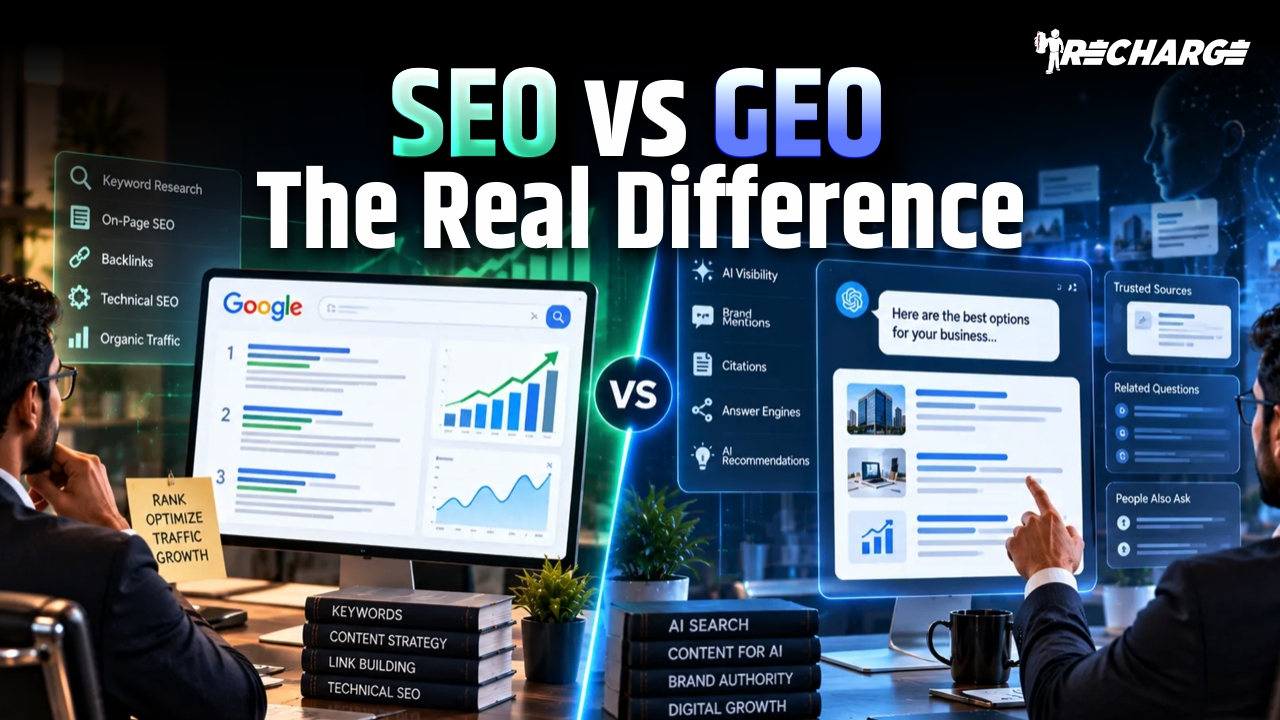
Search is changing faster than ever. A few years ago, getting to the first page of Google was the biggest goal for most businesses. Today, people are asking questions directly in ChatGPT, reading Google AI Overviews, checking Perplexity, and expecting instant answers before clicking a website.
That shift has introduced a new term into digital marketing conversations: GEO, or Generative Engine Optimisation.
Many business owners now wonder whether SEO is becoming outdated or if they should invest in GEO instead. The reality is much simpler. SEO and GEO are not competitors-they solve different parts of the same visibility challenge.
If your business wants to stay visible across Google Search and AI-powered search experiences, understanding the difference between SEO vs GEO is becoming increasingly important.
SEO builds organic visibility, while GEO helps AI understand your content
The biggest difference is that SEO focuses on helping your website rank in traditional search results, while GEO focuses on increasing your chances of being surfaced or cited by AI-powered search experiences like ChatGPT and Google AI Overviews.
SEO (Search Engine Optimisation) improves your website’s visibility in search engines by making pages relevant, technically strong, and useful for users.
GEO (Generative Engine Optimisation) focuses on making your content easier for generative AI systems to understand, trust, and reference when answering questions.
The relationship looks like this:
| SEO | GEO |
| Traditional Google rankings | AI-generated answers |
| Organic search traffic | AI search visibility |
| Keyword optimisation | Context and entity optimisation |
| Search intent | Conversational intent |
| Website clicks | Citations and mentions |
The important thing to remember is that GEO doesn’t replace SEO. Instead, it builds on many of the same quality signals.
What is Generative Engine Optimisation (GEO)?
Generative Engine Optimisation is the process of improving how your brand and content appear in AI-powered search experiences.
Instead of only targeting keyword rankings, GEO helps your content become useful enough for AI systems to reference when generating answers.
For example, someone might ask:
“What’s the best marketing strategy for a startup?”
Rather than listing ten websites, ChatGPT or Google AI Overviews may combine information from several trusted sources into one response.
Your goal is to become one of those trusted sources.
Effective generative search optimisation usually involves:
- Original content
- Clear explanations
- Strong topical authority
- Trustworthy information
- Good website structure
- Helpful internal linking
Businesses exploring long-term AI visibility often combine GEO with broader digital marketing strategies rather than treating it as a separate tactic. You can see how that fits into a full-service approach on the Recharge Studio website .
AEO and GEO are related, but they are not the same
Another term that’s becoming popular is AEO, which stands for Answer Engine Optimisation.
If you’ve searched for what is AEO or AEO meaning, the easiest way to understand it is this:
- SEO helps people find your website.
- AEO helps answer engines deliver direct answers.
- GEO helps generative AI build better responses using trustworthy information.
Think of them as three connected layers.
| Optimisation | Main Goal |
| SEO | Rank webpages |
| AEO | Answer questions directly |
| GEO | Improve AI-generated visibility |
For businesses, this means your content should answer questions clearly before expanding into detailed explanations.
That’s one reason conversational content performs better in modern search experiences.
Businesses still need SEO because AI search depends on strong foundations
Some marketers believe AI SEO has replaced traditional optimisation.
It hasn’t.
Google’s AI-powered search experiences continue to rely on many of the same quality signals that support regular Search visibility. Good technical SEO, crawlable pages, helpful content, and clear site structure still matter.
Start with the basics.
Make sure your website has:
- Fast loading pages
- Mobile-friendly design
- Clear heading structure
- Internal linking
- Indexable pages
- Helpful content
- Logical navigation
When these foundations are strong, AI systems have a much easier time understanding your website.
For example, if someone reads about generating business enquiries, they should naturally discover relevant examples through connected content like Recharge Studio’s Lead Generation portfolio rather than reaching a dead end.
GEO works best when your content demonstrates real expertise
One of the biggest ranking factors in AI search is credibility.
AI systems already have access to thousands of similar articles. They don’t need another generic blog repeating basic advice.
Instead, they reward content that offers something genuinely useful.
That means including:
- Real campaign insights
- Practical examples
- Updated information
- Original observations
- Clear explanations
- Trustworthy references
For example, instead of writing:
“Social media helps businesses grow.”
Explain how combining paid advertising, organic content, and conversion-focused landing pages improved results for a business.
That kind of practical experience strengthens E-E-A-T signals and improves overall content quality.
A connected content strategy also helps. Businesses interested in improving brand visibility can explore how Social Media Marketing works alongside broader digital campaigns instead of treating every channel separately.
SEO and GEO work better together than apart
The smartest businesses aren’t choosing between SEO vs GEO.
They’re combining both.
A practical strategy looks like this:
Continue investing in SEO
- Improve technical performance.
- Build topical authority.
- Strengthen internal linking.
- Optimise important service pages.
- Publish useful content consistently.
Add GEO-friendly improvements
- Answer real customer questions.
- Use conversational language.
- Build entity-based content.
- Include original insights.
- Make information easy to understand.
This combination improves visibility across Google Search, ChatGPT, Google AI Overviews, Bing Copilot, and other AI-powered search experiences.
Businesses running campaigns across multiple channels often see stronger results when content, paid marketing, and brand messaging work together, similar to Recharge Studio’s Multi-Channel Campaign approach .
The future belongs to businesses that optimise for both people and AI
Search is no longer limited to one platform.
Customers might discover your brand through Google Search, ask ChatGPT for recommendations, compare answers in Perplexity, and only then visit your website.
That’s why the question isn’t whether GEO will replace SEO.
The better question is:
How can your content become valuable wherever people search?
The businesses that win in AI search are usually the same ones creating trustworthy, helpful, and experience-driven content consistently.
If you’re planning your next SEO strategy or want to prepare your website for AI-powered search, you can contact Recharge Studio or book a meeting to discuss practical ways to improve long-term search visibility.
Conclusion
The debate around SEO vs GEO doesn’t have a single winner because both play different roles. SEO helps people discover your website through traditional search, while Generative Engine Optimisation improves how AI systems understand and surface your content.
As AI-powered search continues to grow, businesses don’t need to abandon SEO. They need to strengthen it while creating content that’s useful enough for AI to trust.
The best long-term strategy is simple: create original content, build authority, maintain strong technical SEO, and optimise for real conversations-not just keywords.
FAQs
1. What does GEO stand for?
GEO stands for Generative Engine Optimisation. It focuses on improving how websites and brands appear in AI-generated search experiences like ChatGPT, Google AI Overviews, and other conversational search platforms.
2. What is the difference between SEO and GEO?
SEO improves rankings in traditional search engines, while GEO helps AI systems understand and potentially reference your content when generating answers. Both rely on helpful content, technical quality, and trust.
3. What is AEO?
AEO means Answer Engine Optimisation. It focuses on creating content that answers user questions clearly so answer engines can present direct responses more effectively.
4. Can SEO and GEO work together?
Yes. The strongest strategy combines traditional SEO with GEO-friendly content. Technical optimisation, topical authority, conversational content, and real expertise work together across both search experiences.
5. How do I optimise for ChatGPT and Google AI Overviews?
Focus on original content, clear answers, strong internal linking, technical SEO, trustworthy information, and topical authority. These fundamentals help improve visibility across both traditional and AI-powered search.
Branding vs Marketing: What’s the Difference?
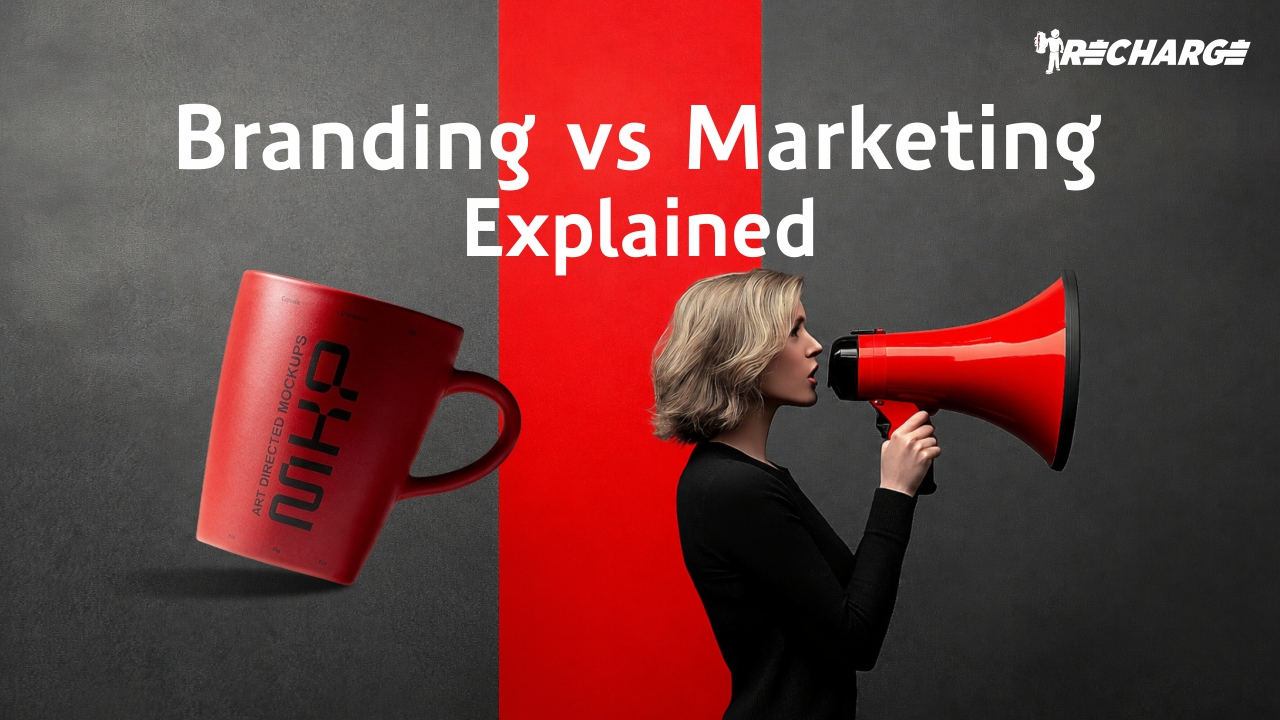
Branding and marketing are often used interchangeably, but they are not the same thing. A business can have a strong marketing campaign and still struggle to build recognition. Similarly, a well-designed brand may not grow if customers are not being reached through effective marketing.
Understanding branding vs marketing helps businesses make better decisions about where to invest their time and budget.
Branding shapes how people perceive and remember a business. Marketing is how that business communicates its value, reaches potential customers and encourages them to take action. One builds the foundation; the other actively takes that brand into the market.
For growing businesses, the real opportunity is not choosing branding or marketing. It is understanding how both work together to create a consistent customer journey from awareness to conversion and retention.
What Is Branding?
Branding is the process of defining and shaping how people recognise and perceive your business. It goes far beyond choosing a logo or colours.
A strong brand can include:
- Brand identity
- Brand positioning
- Brand personality
- Brand voice
- Brand messaging
- Visual identity
- Logo design
- Brand guidelines
- Value proposition
- Brand reputation
Branding answers questions such as Who are we? What do we stand for? Who do we serve? Why should customers remember us?
For example, two companies may offer similar services, but customers may perceive one as more premium, innovative, trustworthy or approachable because of its branding.
This is why business branding plays an important role in differentiation and customer perception.
What Is Marketing?
Marketing focuses on getting your business, products or services in front of the right audience and encouraging them to take action.
A marketing strategy can include:
- SEO
- PPC and paid advertising
- Content marketing
- Social media marketing
- Email marketing
- Performance marketing
- Lead generation
- ATL marketing
- BTL marketing
- TTL marketing
- Multi-channel marketing
Marketing is closely connected to the customer journey. It can help a business generate awareness, attract website visitors, nurture prospects and ultimately drive enquiries, purchases or other conversions.
In simple terms, branding creates the identity, while marketing communicates and promotes it.
Branding vs Marketing: What Is the Difference?
The main difference between branding and marketing is their purpose.
| Branding | Marketing |
| Defines who the business is | Promotes what the business offers |
| Builds recognition and perception | Generates awareness, traffic and demand |
| Focuses on long-term identity | Often focuses on specific campaigns and objectives |
| Creates consistency | Uses channels to reach customers |
| Builds emotional connection | Encourages action and conversion |
Branding is the foundation behind how your business presents itself. Marketing uses that foundation to communicate with the market.
A campaign may generate thousands of clicks, but if the brand experience is inconsistent, customers may struggle to remember or trust the business.
Brand Strategy vs Marketing Strategy
A brand strategy focuses on the long-term direction and positioning of the brand. It considers your target audience, competitive positioning, personality, messaging and the perception you want to create.
A marketing strategy focuses on how you will reach that audience and achieve business objectives through specific channels and campaigns.
For example, a brand strategy may establish a business as a premium, expert-led service provider. The marketing strategy can then use SEO, PPC, content, social media and email marketing to communicate that positioning to potential customers.
This distinction is important because marketing campaigns should not feel disconnected from the brand.
Does Branding Come Before Marketing?
Ideally, branding should provide a clear foundation before major marketing activity begins. Your audience, positioning, messaging and visual identity should be reasonably defined before investing heavily in campaigns.
However, branding and marketing are not completely linear.
Existing businesses can discover through marketing campaigns that customers perceive their brand differently from what they intended. That insight can lead to improvements in messaging, positioning or visual identity.
So, while branding often comes first strategically, both areas should continue developing together.
Why Branding Is Important for Business
Strong branding can make your business easier to recognise and differentiate in a competitive market.
When customers repeatedly encounter consistent messaging, visuals and experiences, they can begin to associate those elements with your company.
Effective branding can support:
- Brand recognition
- Customer trust
- Brand differentiation
- Customer loyalty
- Stronger customer perception
- Consistent communication
- Competitive positioning
This becomes particularly valuable when several businesses offer similar products or services. A distinctive brand gives customers another reason to remember and choose you.
Why Marketing Is Important for Business
Even a strong brand needs visibility. Marketing helps connect the brand with potential customers.
Effective marketing can help businesses:
- Reach target audiences
- Generate website traffic
- Create leads
- Increase enquiries
- Drive sales
- Build brand awareness
- Retain customers
- Measure campaign performance
SEO can help capture people actively searching for solutions. Paid advertising can reach targeted audiences quickly. Social media can build engagement, while content marketing can demonstrate expertise.
The strongest results often come when these activities work together rather than operating as disconnected campaigns.
Branding vs Marketing for Small Businesses
For small businesses, deciding where to invest can be particularly challenging.
Marketing may appear more urgent because it can generate immediate traffic and leads. However, investing only in marketing without a clear brand can result in inconsistent messaging and weak differentiation.
At the same time, spending heavily on branding without having a plan to reach customers may not produce meaningful business growth.
A practical approach is to establish a clear brand foundation and then build marketing activities around it.
For example, define your positioning, target audience, messaging and visual identity first. Then use SEO, social media, paid advertising, content and lead generation to reach that audience.
How Branding and Marketing Work Together
Think of branding as the identity and promise, while marketing is the communication and distribution.
A customer might first discover your business through a Google search. They then visit your website, see your visual identity, read your content, view social media posts and eventually contact your team.
Every interaction contributes to their perception of your brand.
If your branding says “premium and professional” but your website, advertisements and social media feel inconsistent, the customer experience becomes confusing.
Strong branding and marketing strategy keeps the message consistent across channels while adapting the communication to each platform.
Branding vs Marketing: Which Is More Important?
Neither is more important in isolation.
Branding gives your business a clear identity and helps shape customer perception. Marketing gets that identity in front of potential customers and encourages them to engage.
A business with great branding but no marketing may remain invisible. A business with aggressive marketing but weak branding may generate attention without building lasting recognition.
The better question is: How can branding and marketing work together to support business growth?
When both are aligned, businesses can build awareness, attract customers, improve conversion opportunities and create stronger long-term relationships.
Build a Stronger Brand and Marketing Strategy with Recharge Studio
At Recharge Studio, we help businesses connect branding with marketing so every customer touchpoint works towards the same business goal. Our approach can cover brand identity, positioning, messaging and creative direction alongside digital marketing, SEO, paid advertising, social media and lead generation.
Whether you are launching a new business, refreshing an existing identity or looking to make your marketing more consistent, we can help create a strategy that connects your brand with the right audience.
From building a recognisable visual identity to planning multi-channel campaigns, our focus is on creating a clear and consistent brand experience that supports awareness, engagement and measurable growth.
Conclusion
The branding vs marketing debate should not be about choosing one over the other. Branding defines how your business is positioned, recognised and remembered, while marketing helps communicate that brand and bring customers into the business.
A clear brand can make marketing more consistent and recognisable, while effective marketing gives the brand the visibility it needs to grow.
For businesses of all sizes, the strongest approach is to build a clear brand foundation and connect it with a focused marketing strategy. When the two work together, every campaign, channel and customer interaction can contribute to a stronger overall business presence.
FAQs
1. What is the difference between branding and marketing?
Branding focuses on defining your business identity, positioning, personality, messaging and customer perception. Marketing focuses on promoting that brand, reaching target audiences and generating actions such as enquiries, purchases or sign-ups. Branding creates the foundation, while marketing uses different channels to communicate that foundation.
2. Branding vs marketing: which is more important?
Neither is more important on its own. Branding helps customers recognise and remember your business, while marketing creates visibility and generates demand. A strong business strategy needs both. Marketing without clear branding can feel inconsistent, while branding without marketing may struggle to reach enough potential customers.
3. Does branding come before marketing?
Branding often provides the foundation for marketing because businesses should understand their positioning, audience, messaging and identity before launching major campaigns. However, branding and marketing can develop together over time as businesses learn more about their customers and competitive market.
4. Why is branding important for small businesses?
Strong branding can help small businesses appear more professional, differentiate themselves from competitors and create recognition within their target market. Consistent visual identity, messaging and positioning can also make marketing activities more recognisable and help customers develop greater familiarity with the business.
5. How does branding affect marketing?
Branding influences how marketing campaigns look, sound and communicate with customers. A clear brand identity provides consistent messaging, visual direction and positioning across SEO, social media, advertising, content and other channels. This can create a more consistent customer experience across the marketing funnel.
6. What is the difference between a brand strategy and marketing strategy?
A brand strategy defines how a business wants to be positioned and perceived, including its audience, personality, messaging and differentiation. A marketing strategy explains how the business will reach that audience through channels such as SEO, PPC, social media, content, email and other marketing activities.
Disclaimer: Marketing and branding results depend on factors such as market conditions, competition, audience behaviour, positioning, campaign execution and business objectives. No branding or marketing strategy can guarantee specific traffic, rankings, leads, conversions or revenue.
Custom IT Solutions to Solve Complex Business Challenges

Running a business today is not as simple as it used to be. Markets change fast, customer expectations shift overnight, and technology keeps moving ahead whether we are ready or not. Many business owners feel stuck between old systems that no longer work and new tools that feel confusing or expensive. This is where custom IT solutions start making real sense.
Instead of forcing your business to fit into ready-made software, custom solutions are designed around how you actually work. They help reduce daily struggles, improve speed, and support growth in a practical way. For Indian businesses, especially growing brands and service companies, this approach often becomes the turning point.
Why One-Size-Fits-All Technology Fails Growing Businesses
Most businesses begin with basic tools. A simple CRM, some spreadsheets, a few marketing platforms. Over time, these tools start creating problems instead of solving them. Teams waste hours switching between systems. Data doesn’t sync properly. Decisions get delayed. This is where business technology solutions need to go deeper. A customised setup connects your sales, marketing, customer support, and reporting in one smooth flow. It saves time and avoids confusion. More importantly, it supports the way your team already works instead of forcing new habits overnight.
Many brands that work with enterprise IT services see immediate improvements in efficiency. Processes become clearer. Errors reduce. Teams feel more confident using technology instead of fearing it.
Turning Digital Transformation into a Practical Process
Digital transformation sounds big and fancy, but for most businesses, it starts with small, smart changes. Maybe your lead tracking is messy. Maybe your marketing campaigns are not connected to your sales follow-ups. Maybe reporting takes days instead of minutes.
This is where digital transformation services matter. The focus is not on adding more tools, but on improving how technology supports daily business decisions. Companies like Recharge Studio work closely with businesses to understand these gaps before building solutions. A good transformation plan improves visibility. Teams collaborate better. Customers get faster responses. And management finally gets data that helps with real planning.
Custom IT Solutions That Actually Scale with Your Business
One common fear business owners have is future growth. “What happens when my team doubles?” or “Will this system handle higher demand?” That’s where scalable IT solutions make a big difference. Custom-built systems grow along with your business. Whether you expand to new cities, add more products, or increase digital campaigns, the technology adapts smoothly. There is no need to start from scratch every year.
For example, businesses running structured campaigns often benefit from integrated systems like this lead generation portfolio. Leads flow directly into sales dashboards. Follow-ups become faster. Conversion tracking stays clean. This saves both time and money.
Marketing and IT Working Together, Not Separately
In many Indian companies, marketing and IT teams work in silos. Marketing runs campaigns. IT manages systems. The result is poor coordination and missed opportunities.
Strong technology-driven business solutions bring both sides together. Your social media campaigns, website traffic, and paid ads connect directly to backend systems. Sales teams see real-time updates. Managers track ROI without manual reports. A good example of this balance can be seen in integrated efforts like this social media marketing portfolio. When marketing data connects properly with IT systems, decisions become faster and more accurate.
Multi-Channel Campaigns Need Smart IT Support
Today’s customers move across platforms. They might see your brand on Instagram, read an email, visit your website, and then call your office. If your systems don’t track this journey properly, you lose valuable insights.
Custom IT setups support multi-channel campaigns by connecting all touchpoints. You understand customer behaviour better. Messaging stays consistent. Campaign performance becomes easier to measure. This approach works especially well when supported by structured frameworks like this multi-channel campaign portfolio. Businesses can manage campaigns without chaos and scale efforts without confusion.
The Role of IT Consulting in Smarter Decision-Making
Many business owners know something needs to change but are unsure where to begin. This is where IT consulting services add real value. Instead of selling tools blindly, consultants study your business flow, challenges, and goals. They recommend what you actually need, not what is trending. This saves money and avoids unnecessary complexity. Consulting also helps during implementation, ensuring teams adapt smoothly without disrupting daily work.
If you want to discuss your challenges openly, a simple step is to book a meeting and explore what kind of solution fits your business best.
Building Long-Term Partnerships, Not Just Systems
Technology works best when it evolves with the business. Custom IT solutions are not one-time projects. They are long-term partnerships focused on improvement, security, and performance. Businesses that treat IT as a strategic asset, not a cost, gain a strong advantage. Systems stay updated. Teams stay productive. Growth becomes easier to manage.
If you are ready to explore possibilities or need clarity on the next step, you can always reach out through the contact page.
Conclusion
Complex business challenges don’t need complicated solutions. They need the right thinking, the right planning, and technology that fits naturally into your workflow. Custom IT solutions help businesses stay flexible, efficient, and future-ready without unnecessary stress.
When technology supports your goals instead of slowing you down, growth feels smoother and more confident. Feel free to explore more details on the website and see how tailored IT solutions can support your business journey.
- Published in Digital Marketing
AI-Powered Analytics for Smarter Business Decision Making
Running a business today feels very different from how it did even five years ago. There is more data, more platforms, more customer touchpoints, and more pressure to take the right call at the right time. Gut feeling still matters, but it can no longer be the only guide. This is where AI-powered business analytics quietly steps in and changes how decisions are made.
Instead of guessing what might work, businesses can now clearly see patterns, behaviour, and future possibilities hidden inside their data. When used correctly, analytics powered by artificial intelligence helps leaders move with confidence, not confusion.
Why businesses are shifting towards AI-driven decisions
Earlier, reports were mostly about what happened last month or last quarter. Today, business owners want to know what is likely to happen next. Artificial intelligence in business makes this possible by reading large volumes of data in minutes and spotting trends that human eyes often miss.
Think about an e-commerce brand noticing a sudden drop in repeat customers. Traditional reports may show the drop, but machine learning analytics can explain why it happened, which customer group is affected, and what action could bring them back. This shift from basic reporting to data-driven decision making helps businesses stay one step ahead instead of always playing catch-up.
Turning raw data into smart business direction
Most companies already collect data from websites, ads, social media, CRM tools, and offline sales. The real challenge is knowing what to do with it. Smart data insights convert these scattered numbers into clear business directions.
For example, a service-based company running paid ads may feel confused about where leads are coming from. With AI analytics, they can clearly track which platform delivers quality leads, which campaign converts better, and where money is being wasted. Many businesses working with digital growth partners like Recharge Studio rely on such insights to fine-tune strategy instead of blindly increasing budgets. The beauty of AI analytics is that it keeps learning. The more data it processes, the sharper its suggestions become.
Predicting outcomes before problems appear
One of the strongest advantages of predictive analytics solutions is foresight. Instead of reacting after something goes wrong, businesses can prepare in advance. A retail brand can predict demand spikes during festivals. A B2B company can forecast lead drop-offs before sales targets are missed. Even internal operations like staff planning and inventory control become smoother when predictions are reliable.
For brands focused on consistent customer acquisition, predictive analytics plays a huge role in improving outcomes from lead-focused campaigns like those seen in lead generation projects. Knowing which audience is most likely to convert saves time, effort, and money.
Making marketing smarter, not louder
Marketing today is not about shouting louder than competitors. It is about speaking more clearly to the right audience. Business intelligence tools powered by AI help marketers understand customer behaviour across platforms. Social media performance, for instance, can look great on the surface but fail to deliver real results. AI analytics reveals which content brings engagement and which actually drives enquiries or sales. Teams handling social media marketing campaigns often use these insights to refine messaging, posting time, and platform focus.
When campaigns run across email, paid ads, social platforms, and websites, AI helps connect the dots. It shows how users move across channels and what finally convinces them to take action. This clarity is especially useful in complex multi-channel campaigns where manual tracking becomes messy.
Real-world business impact beyond dashboards
AI analytics is not just about graphs and charts. Its real value lies in day-to-day decision making. Sales teams can prioritise high-intent leads. Marketing managers can allocate budgets more wisely. Founders can plan growth with fewer surprises. Even customer support benefits. Patterns in complaints or queries can highlight product gaps or service issues before they damage brand reputation. Over time, these small improvements build stronger trust and smoother operations.
Businesses that adopt analytics early often notice one clear change. Meetings become shorter, discussions become clearer, and decisions are backed by numbers rather than opinions.
Getting started without feeling overwhelmed
Many business owners hesitate because AI sounds complex or expensive. In reality, the right setup does not have to be complicated. What matters most is clarity of goals. Whether the focus is growth, retention, efficiency, or cost control, analytics tools can be aligned accordingly. Working with the right digital partner also makes a difference. Experts who understand both data and real business challenges help translate insights into action. If you are unsure where to begin or how analytics fits your current systems, starting a conversation through the contact page can bring clarity.
For teams that prefer a structured discussion, scheduling time via a book a meeting option often helps align expectations and identify quick wins.
Conclusion
AI-powered analytics is no longer a luxury reserved for large corporations. It is becoming a practical tool for businesses that want to grow smarter, not just faster. When decisions are guided by data, risks reduce and confidence increases.
The key lies in using insights thoughtfully, not blindly. With the right approach, analytics becomes a trusted business companion rather than a confusing tech layer. Feel free to explore more details and practical examples on the website to see how data-driven thinking can quietly transform everyday business decisions.
- Published in Digital Marketing, Marketing
AI Chatbots to Automate Customer Support 24/7 Effortlessly
Running a business today means customers expect instant replies. Late-night questions, weekend doubts, quick follow-ups after seeing an ad everything needs attention. But keeping a full support team active round the clock is not easy. This is where AI chatbots quietly step in and change the game.
AI chatbots are no longer just pop-up boxes with robotic replies. They have become smart, reliable support partners that work 24/7, handle routine queries, and support marketing efforts without sounding cold or mechanical. When used properly, they don’t just reduce workload. They strengthen brand trust and support long-term product awareness.
Why customer support matters in modern brand building
Every best brand building campaign today focuses on experience, not just visibility. A customer might discover your product through a social media post, an ad, or a referral. But their real connection starts when they ask a question and receive a clear, friendly response.
If replies are delayed, interest drops. If answers are confusing, trust breaks. AI chatbots help maintain that first impression by offering instant, consistent support. This becomes especially powerful during a product campaign or new product campaign, where curiosity is high and response time matters the most. Brands that invest in smooth customer interaction often see better engagement across their advertising campaign for a new product. Support and marketing start working together instead of operating separately.
How AI chatbots fit naturally into product promotion campaigns
A product promotion campaign usually runs across multiple platforms ads, landing pages, emails, and social media. Customers move fast between channels, and their questions change at every stage. AI chatbots act as a bridge. Someone clicks an ad, lands on your site, and asks about pricing. Another user checks features after watching a reel. A chatbot handles both without delay.
When aligned with smart campaign planning like the strategies seen on Recharge Studio, chatbots support marketing goals without feeling pushy. They answer what users want to know, guide them gently, and let the product speak for itself. This approach supports product awareness while keeping conversations natural.
Turning customer queries into leads automatically
Customer support is not just about solving problems. It’s also about spotting opportunities. AI chatbots can capture names, emails, preferences, and intent without sounding like a sales agent.
For businesses running lead-driven campaigns, this is extremely useful. During high-traffic campaigns, chatbots ensure no query goes unanswered. They quietly collect data and pass warm leads to the sales team. This works especially well when combined with focused strategies like those used in lead generation campaigns. Instead of waiting for follow-ups, businesses get real-time engagement that feels personal and smooth.
Supporting social media and multi-channel campaigns seamlessly
Today’s customer journey is rarely linear. Someone might discover your product on Instagram, search on Google, visit your site, and message you later. AI chatbots help keep this journey connected. For brands investing in social media marketing, chatbots reply instantly to common questions and guide users to the right pages. This keeps engagement alive even when teams are offline.
When businesses run wider campaigns across platforms, chatbots become even more valuable. They support multi-channel campaign efforts by maintaining message consistency and ensuring customers never feel ignored, no matter where they connect from.
Reducing pressure on teams without losing the human touch
Many business owners worry that automation might feel impersonal. The reality is different when chatbots are designed thoughtfully. They handle repetitive questions so human teams can focus on real conversations that need empathy and judgement.
Instead of replacing people, chatbots support them. They reduce response fatigue, avoid burnout, and improve overall efficiency. This balance allows brands to scale support while maintaining warmth in communication. For growing businesses planning long-term product promotion campaigns, this combination of automation and human oversight is practical and sustainable.
Making AI chatbots work for your business goals
AI chatbots are not a plug-and-play solution. Their success depends on how well they are aligned with business objectives. They should reflect your brand tone, understand customer intent, and support both service and marketing goals. Brands that treat chatbots as part of their larger strategy see better results. Whether the focus is brand building, product awareness, or campaign conversions, chatbots work best when integrated early into planning.
Businesses looking to implement this effectively can explore solutions and guidance directly on the Recharge Studio website or connect with experts who understand both technology and marketing.
Conclusion
AI chatbots have quietly become one of the most useful tools in modern customer support. They work nonstop, respond instantly, and support marketing efforts without interrupting the customer experience.
When used smartly, they strengthen best brand building campaigns, support new product campaigns, and improve product awareness across channels. The key lies in thoughtful integration and clear intent. If you’re exploring ways to improve customer interaction while supporting your next product promotion campaign, feel free to explore more details on the website or book a meeting to understand what fits your business best.
- Published in Digital Marketing, Marketing
Website Design Techniques That Convert Visitors to Buyers
Every day, people visit websites with curiosity. They scroll, click, read a little, and then quietly leave. This happens even on websites that look good on the surface. The real difference between a website that only gets visitors and one that creates buyers lies in how it is designed to guide human behaviour.
A strong website is not just about colours, fonts, or animations. It is about understanding how people think, what they expect, and how easily they can take the next step. In the Indian digital market, where attention spans are short and choices are many, conversion-focused web design has become a real business need, not a luxury. Let’s look at the website design techniques that genuinely help turn visitors into paying customers.
Design With a Clear Purpose, Not Just Beauty
Many businesses focus only on making their website “look premium”. But a good-looking site without direction confuses users. Every page should have a clear purpose. Do you want the visitor to enquire, book a call, download something, or make a purchase? This is where website design for lead generation plays a major role. Pages should be structured in a way that gently pushes users towards action. Headlines must speak to the visitor’s problem. Subheadings should show solutions. Buttons should be visible, not hidden.
Agencies that build performance-driven websites, like the ones showcased focus on clarity first and visuals second. The result feels natural, not forced.
User Experience Is What Keeps People Moving
User experience (UX) design is often misunderstood. It’s not only about smooth scrolling or fast loading. It’s about making the journey effortless.
If someone lands on your site and cannot find basic information within a few seconds, they lose interest. Simple navigation, logical page flow, and readable content matter more than fancy layouts. Think of a service-based business. If contact details, services, and proof of work are easy to find, trust builds faster. Many lead-driven projects are shown to follow this exact thinking. The user always knows where to go next. Good UX respects the visitor’s time. That respect turns into trust, and trust turns into conversions.
Landing Pages That Speak One Clear Message
High converting landing pages never try to say everything at once. They focus on one message, one offer, and one action.
A strong landing page has:
- A headline that connects emotionally
- Simple supporting text
- One main call-to-action
- Visuals that support the message, not distract
For example, if the goal is to generate leads, the page should remove unnecessary links and keep the visitor focused. Forms should be short. Asking for too much information scares people away. Many businesses make the mistake of treating landing pages like regular website pages. When designed properly, landing pages feel more like a guided conversation than a sales pitch.
Call-to-Action Placement Makes a Big Difference
Call-to-action optimization is often ignored, but it directly impacts results. A CTA should feel like a natural next step, not a pushy command. Buttons like “Talk to Our Team” or “Schedule a Quick Discussion” work better than aggressive sales lines. Placement matters too. CTAs should appear when the visitor is mentally ready, not randomly placed everywhere. Some pages guide users gently towards contact points such as Recharge studio or booking options like without breaking the flow. That balance helps users feel in control.
When CTAs align with user intent, clicks increase naturally.
Mobile Experience Is No Longer Optional
Most users today browse websites on their phones. Responsive website design is no longer a feature; it’s the foundation.
If a site looks perfect on desktop but feels cluttered on mobile, conversions drop sharply. Buttons become hard to tap. Text feels too small. Pages load slowly. A responsive design adapts smoothly across devices. Content remains readable. CTAs stay accessible. Navigation stays simple. In India, where mobile-first browsing is common across cities and towns, this aspect directly impacts sales and enquiries.
Social Proof Builds Instant Confidence
People trust people. Adding real examples of work, campaigns, and results creates confidence.
When visitors see real brand stories, like social Media campaigns at or integrated efforts at, it answers silent doubts in their mind. This supports website conversion rate optimization (CRO) without extra persuasion. Proof does the talking. Testimonials, case snippets, and portfolio visuals should feel authentic, not polished marketing talk.
Small Optimisation Brings Big Results Over Time
Conversion improvement doesn’t happen overnight. Small changes make a big difference over time. Changing button text. Simplifying a form. Improving page speed. Adjusting content layout. These are practical CRO steps that many businesses overlook.
Tracking user behaviour and refining pages slowly creates steady growth. Websites that treat design as an evolving tool perform better than those that treat it as a one-time project.
Conclusion
A website should feel like a helpful guide, not a silent brochure. When design, content, and user experience work together, visitors feel comfortable taking action. If your website attracts traffic but struggles to convert, the issue is rarely the audience. It’s usually the experience.
Feel free to contact and get more details on the website and understand how thoughtful design can quietly turn visitors into buyers.
- Published in Digital Marketing
Experiential Marketing Campaigns That People Remember Always

Marketing today is not just about being seen. It is about being felt. People forget ads quickly, but they remember experiences for years. Think about the last brand activity that made you stop, smile, click a photo, or tell a friend. That is the real power of experiential marketing campaigns.
In a world full of scrolling, skipping, and ignoring, brands that create real moments win attention naturally. From mall activations to live demos and city-level roadshows, memorable brand experiences are shaping how customers connect with businesses in India. Let’s talk about why these experiences stay in people’s minds and how brands can use them the right way.
Why Experiences Create Stronger Brand Memory
A normal ad talks to people. An experience talking with them. When customers touch, feel, play, or participate, the brand becomes part of their personal memory. That emotional link is hard to break. Indian consumers especially enjoy interactive moments. Whether it’s a festival stall, a college event, or a weekend mall activity, people love engagement. This is where experiential marketing campaigns create real impact. They turn simple promotions into stories customers enjoy sharing.
Brands that focus on customer experience marketing don’t just sell products. They build trust, excitement, and recall that lasts much longer than a paid post.
Interactive Marketing Ideas That Pull People In
One-way communication is boring now. Brands that invite participation always stand out. Simple interactive marketing ideas can turn strangers into brand fans within minutes.
Think of spin-the-wheel games, live contests, AR filters at kiosks, or instant giveaways for small actions. These ideas don’t need massive budgets. They need smart thinking and smooth execution. Many brands plan such activations with experienced teams like Recharge Studio, known for creating engaging on-ground and digital experiences that feel natural, not forced. When interactions feel fun, people stay longer and remember more.
On-Ground Activation Campaigns That Feel Real
Digital is powerful, but physical presence still has magic. On-ground activation campaigns work because they bring brands into real-life spaces where people already are. Malls, corporate parks, colleges, exhibitions, and local events are perfect places for live engagement. A skincare brand offering free skin analysis. A tech brand giving hands-on demos. A food brand letting people taste and vote.
These moments feel genuine. They also allow direct feedback. Many brands use such activities for lead collection and customer insights, similar to structured lead generation campaigns that combine experience with data smartly.
Live Marketing Experiences Build Trust Faster
When people see a product live, doubts reduce. Live marketing experiences allow brands to explain, demonstrate, and answer questions instantly. This builds confidence far quicker than static ads.
For example, a fitness brand running live workout demos or a home product brand showcasing real use cases in front of customers. These experiences show transparency. They also humanise the brand. Well-planned live campaigns often become content gold. Videos, reactions, and stories from these events feed social media for weeks. Brands that connect live experiences with strong social media marketing get double value from one campaign.
Brand Engagement Strategies That Go Beyond Visibility
Visibility is easy. Engagement is not. Smart brand engagement strategies focus on involvement, not impressions. Instead of pushing logos everywhere, strong experiential campaigns focus on emotions. Fun. Curiosity. Surprise. Pride. When people feel something, they engage naturally.
Multi-touch campaigns work best here. A teaser online, a live event offline, and post-event digital engagement together create a full journey. Brands that use multi-channel campaign planning see better recall and longer engagement.
Measuring What Truly Matters
Experiential marketing is not just about crowd size. It’s about quality interaction. Time spent. Conversations started. Leads captured. Content created.
Good campaigns track responses through QR codes, sign-ups, polls, or instant feedback. This data helps brands understand what worked and what didn’t. Professional teams like those behind Recharge Studio’s portfolio often design experiences with measurement built in, so creativity and performance go hand in hand.
Choosing the Right Partner for Experiential Success
Great ideas need great execution. From permissions and logistics to staff training and audience flow, every detail matters. One small miss can break the experience.
Working with an experienced agency saves time and stress. If you’re planning your next activation or brand experience, you can explore ideas or book a meeting to discuss goals clearly before execution begins. Clear communication and planning make experiences smoother and more impactful.
Conclusion
People may forget your ad, but they won’t forget how your brand made them feel. Experiential marketing campaigns create those feelings that stay long after the event ends. When done right, they turn marketing into memories, customers into advocates, and brands into stories people love sharing.
If you’re curious to see how creative experiences are built and executed, feel free to explore more details on the website or contact the team to understand what suits your brand best.
- Published in Digital Marketing
- 1
- 2