
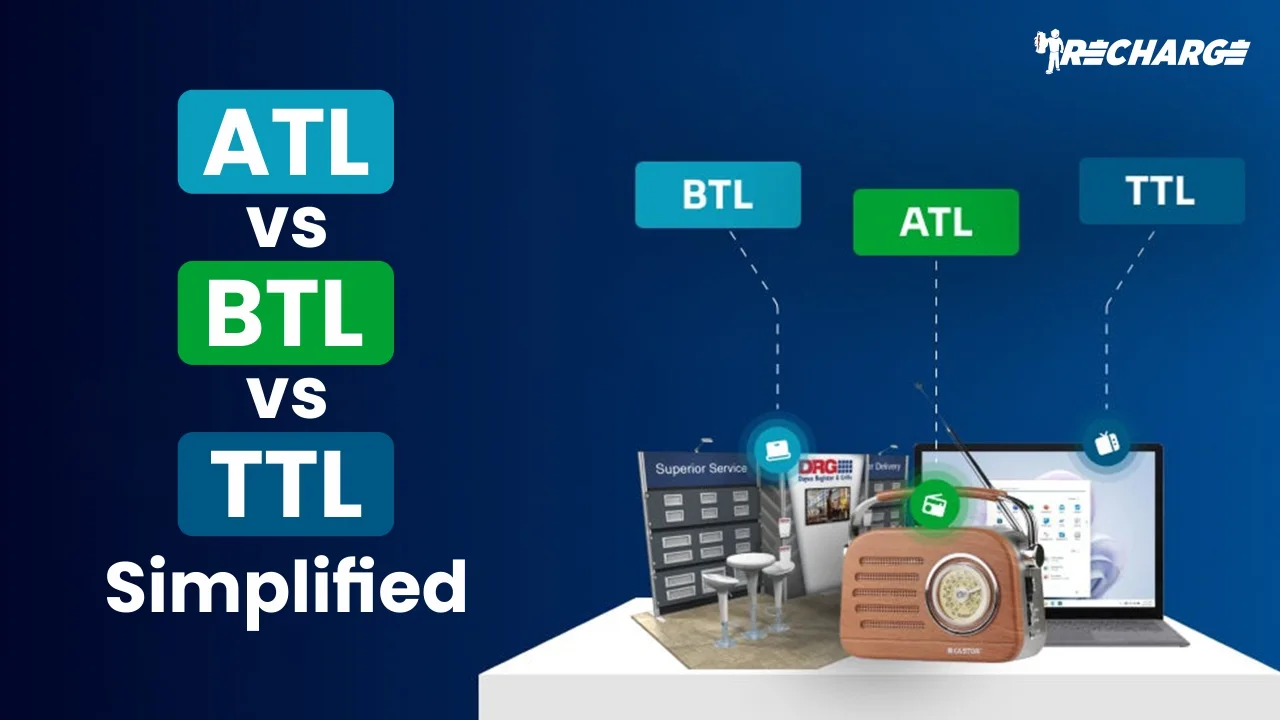
Choosing the right marketing approach is not simply about deciding where to advertise. Businesses need to understand who they want to reach, what they want to achieve and where customers are in their buying journey.
This is where ATL vs BTL vs TTL marketing becomes important. ATL, BTL and TTL represent three different approaches to marketing communication. Above The Line (ATL) focuses on reaching large audiences through mass media. Below The Line (BTL) focuses on targeted and direct customer engagement. Through The Line (TTL) combines both approaches to create a more integrated marketing strategy.
While the three methods have different strengths, modern businesses often use them together. The right mix can support brand awareness, customer engagement, lead generation and conversions across different stages of the marketing funnel.
What Is ATL Marketing?
ATL marketing, or Above The Line marketing, focuses on reaching a broad audience through mass media channels. The primary objective is generally to build brand awareness and create widespread visibility rather than target individual customers with highly personalised messages.
Common ATL marketing channels include:
- Television advertising
- Radio advertising
- Newspaper advertising
- Magazine advertising
- Billboard advertising
- Outdoor advertising
- Cinema advertising
For example, a consumer brand launching nationally may use television and outdoor advertising to introduce its product to millions of potential customers.
ATL can be particularly useful when a business wants to establish or strengthen brand recognition. However, because the audience is broad, measuring direct conversions can sometimes be more difficult than with highly targeted campaigns.
Contact Recharge Studio for : Creative Brand Solutions to Elevate Your Business Presence
What Is BTL Marketing?
BTL marketing, or Below The Line marketing, takes a more targeted approach. Instead of communicating with a mass audience, businesses focus on specific customer groups, locations or individuals.
BTL marketing examples include:
- Email marketing
- SMS marketing
- Trade shows
- Event marketing
- Product demonstrations
- Sampling campaigns
- Sales promotions
- Direct marketing
- Targeted advertising
BTL campaigns are often designed to encourage a specific response, such as making an enquiry, attending an event, trying a product or making a purchase.
For example, a company could run an in-store product demonstration or send a targeted promotional campaign to existing customers. This makes BTL particularly useful for customer engagement, lead generation and direct response marketing.
What Is TTL Marketing?
TTL marketing, or Through The Line marketing, combines ATL and BTL activities within one integrated marketing campaign.
Rather than treating mass media, digital channels, direct marketing and customer activation as separate activities, TTL connects them around a common marketing objective.
A TTL campaign might use television or outdoor advertising to create awareness, social media to engage the audience, email or SMS to nurture prospects and targeted promotions to encourage conversion.
This approach is often described as 360-degree marketing, integrated marketing or full-funnel marketing because different channels work together across the customer journey.
Contact for : Corporate Gifts For Employees, Clients & Companies
ATL vs BTL vs TTL: What Is the Difference?
The simplest way to understand the difference between ATL BTL and TTL marketing is to look at their audience, purpose and communication style.
| Marketing Approach | Main Focus | Typical Channels | Best For |
| ATL | Mass audience | TV, radio, print, outdoor, cinema | Brand awareness |
| BTL | Targeted audience | Email, SMS, events, promotions, demonstrations | Engagement and lead generation |
| TTL | Integrated approach | Combination of ATL, BTL and digital | Full-funnel growth |
ATL is generally broader, BTL is more targeted and TTL connects multiple approaches into one coordinated strategy.
ATL vs BTL Marketing Examples
Consider a new restaurant chain entering a major city.
An ATL campaign could involve billboards, radio advertising and local newspaper placements to make people aware of the brand.
A BTL campaign could involve opening events, promotional offers, product sampling, SMS campaigns or local influencer collaborations aimed at specific audiences.
Both can create value, but they serve different purposes.
ATL builds visibility at scale, while BTL creates more direct opportunities for interaction and response.
When Should You Use ATL Marketing?
ATL marketing can make sense when your primary objective is brand awareness and you need to reach a large audience.
It may be suitable when:
- Launching a new brand
- Expanding into new markets
- Building national awareness
- Strengthening brand recognition
- Supporting a major product launch
- Reaching a broad consumer audience
Media planning and media buying are especially important because large-scale advertising can require significant investment. Businesses need to consider audience reach, frequency, location and campaign objectives before committing to major ATL activity.
When Should You Use BTL Marketing?
BTL marketing is useful when you want to reach a more specific audience and encourage measurable action.
It can work well for:
- Lead generation
- Customer acquisition
- Sales promotions
- Local campaigns
- Product trials
- Events and trade shows
- Customer retention
- Direct response campaigns
BTL is also useful when businesses have detailed audience information and want to personalise communication based on customer needs or behaviour.
When Should You Use TTL Marketing?
TTL marketing can be effective when businesses want both broad visibility and measurable customer engagement.
A typical TTL campaign could begin with an outdoor or television campaign to create awareness. Digital advertising and social media can then reinforce the message, while email marketing, retargeting and promotional campaigns encourage prospects to take action.
This creates a connected customer journey rather than isolated marketing activities.
For businesses focused on sustainable growth, TTL can support a full-funnel marketing strategy covering awareness, consideration, conversion and retention.
ATL vs BTL vs TTL for Brand Awareness and Lead Generation
The best approach depends heavily on the campaign objective.
For brand awareness, ATL can provide broad reach, while TTL can combine mass visibility with digital engagement.
For lead generation, BTL and TTL can often provide more opportunities for measurable action. Targeted advertising, social media marketing, email campaigns, events and landing pages can move potential customers further through the funnel.
For many businesses, the strongest approach is not choosing ATL or BTL exclusively. A coordinated strategy can use each channel where it makes the most sense.
How to Choose Between ATL, BTL and TTL Marketing
Before creating a campaign, consider five key questions:
- Who is your target audience?
- What stage of the marketing funnel are they in?
- Is your priority awareness, engagement or conversion?
- How much advertising budget is available?
- How will campaign performance and ROI be measured?
A business launching a mass-market product may need ATL visibility. A B2B company generating qualified leads may benefit more from targeted BTL activity. A growing brand looking to connect awareness with customer acquisition may benefit from TTL.
The important point is to build the strategy around business objectives rather than selecting channels simply because competitors are using them.
Read More : Experiential & Activations
Why Integrated Marketing Is Becoming More Important
Customers rarely interact with a brand through only one channel. Someone might see a billboard, search for the company online, watch a social media video, visit the website and later receive a remarketing advertisement.
An integrated marketing strategy connects these interactions.
When ATL, BTL, digital marketing, social media, performance marketing and direct communication support the same brand message, businesses can create a more consistent customer experience.
This is why ATL BTL integration can be particularly valuable for businesses looking to build both awareness and measurable growth.
Build Integrated Campaigns with Recharge Studio
At Recharge Studio, in indore we help businesses connect different marketing channels into campaigns built around clear business objectives. Our approach can combine brand marketing, digital advertising, social media, lead generation and multi-channel campaigns rather than treating each activity separately.
Whether you need an ATL campaign for wider brand awareness, BTL activity for targeted customer engagement or a TTL strategy connecting online and offline marketing, Recharge Studio, team can help with campaign planning, creative direction, audience targeting and performance measurement.
The goal is to create marketing communication that reaches the right audience, supports the customer journey and contributes to measurable business growth.
Conclusion
The ATL vs BTL vs TTL marketing decision depends on what you want your campaign to achieve. ATL is built around mass reach and brand awareness, BTL focuses on targeted engagement and direct response, while TTL brings multiple approaches together through an integrated strategy.
For many modern businesses, combining channels can provide a stronger customer journey than relying on a single marketing method. The most effective strategy considers audience, objectives, budget, customer behaviour and measurable outcomes before selecting the right channel mix.
FAQs
1. What is the difference between ATL, BTL and TTL marketing?
ATL focuses on mass-market communication through channels such as television, radio and outdoor advertising. BTL focuses on targeted activities such as email, events and promotions. TTL combines ATL and BTL with digital and other channels to create an integrated, full-funnel marketing strategy.
2. Which is better, ATL, BTL or TTL marketing?
There is no universally better option. ATL can be useful for large-scale brand awareness, BTL can support targeted engagement and lead generation, while TTL can connect awareness, engagement and conversion. The right approach depends on the audience, marketing objective, budget and customer journey.
3. What are some ATL BTL TTL marketing examples?
An ATL example could be a television or billboard campaign. A BTL example could be an event, product demonstration or targeted email campaign. A TTL campaign could combine television advertising with social media, search advertising, email marketing and promotional activities around one central campaign.
4. When should a business use ATL marketing?
ATL can be suitable when a business wants to reach a large audience and build brand awareness. It may work well for national launches, consumer brands, market expansion and major campaigns where broad visibility is more important than highly personalised communication.
5. When should a business use BTL marketing?
BTL can be useful when businesses want to communicate with specific audiences and encourage measurable actions. It is commonly used for lead generation, sales promotions, events, product demonstrations, direct marketing, customer retention and targeted advertising campaigns.
6. How does TTL marketing support lead generation?
TTL can combine awareness-building activities with targeted digital and direct marketing. For example, ATL advertising can introduce the brand, while social media, search advertising, landing pages, email and remarketing can encourage interested audiences to enquire or purchase.
7. Why is an integrated marketing strategy important?
Customers interact with brands across multiple touchpoints. An integrated strategy helps maintain consistent messaging across offline and online channels while connecting awareness, engagement and conversion. This can make the customer journey more coordinated and help businesses measure the contribution of different marketing activities.
Disclaimer: Marketing performance depends on factors such as audience, industry, budget, creative quality, media costs, campaign execution and market conditions. No marketing strategy can guarantee specific reach, leads, conversions or return on investment.
